

Yes, buying a car overseas and importing it to the US can save serious money. European luxury vehicles typically cost 15 to 25% less in their home countries. Classic Japanese sports cars can come in at half the US price. Vehicles over 25 years old bypass EPA and DOT compliance entirely. Military members stationed overseas have access to factory-direct pricing through dedicated programs. The process involves import duties, compliance checks, customs clearance, and ocean freight — but done right, the savings are real.
Buying a car overseas sounds complicated. It is not as complicated as most people think, and for the right vehicle, the savings make every step worthwhile.
Whether you are a military member stationed abroad looking to ship a vehicle home, a car collector hunting a JDM import unavailable in the US, or someone who found a better price on a Mercedes-Benz in Germany than anything the local dealership can offer — this guide covers the entire process from purchase to delivery at your door.
- Why buy a car overseas
- Best countries to buy from
- Military and civilian employees stationed overseas
- The 25-year rule for classic cars
- Foreign nationals buying from the US
- EPA and DOT compliance requirements
- Full cost breakdown
- Shipping methods: RoRo vs container
- Customs clearance and documentation
- Registration and license plates
- Red flags and due diligence
- Frequently asked questions
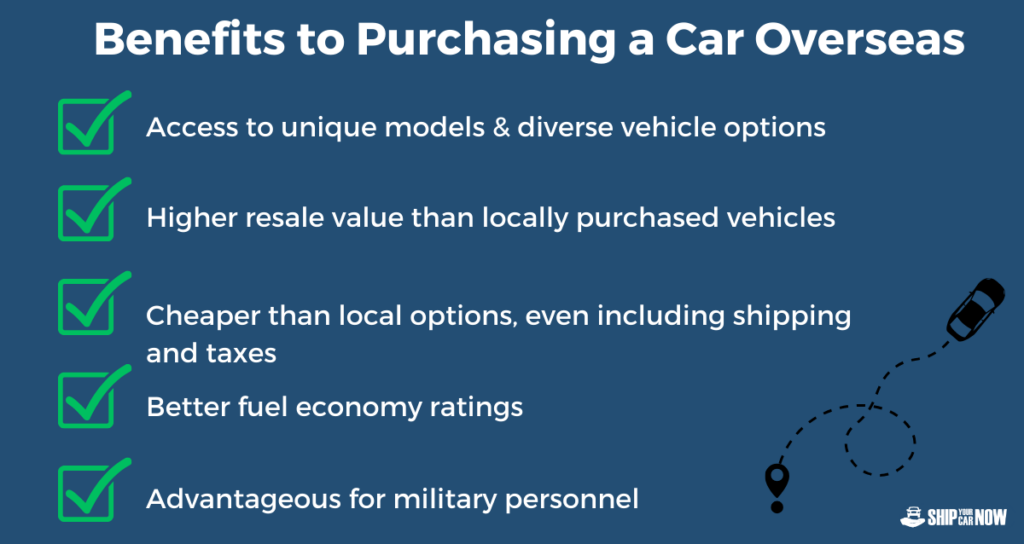
Why Buy a Car Overseas
The case for buying a car abroad comes down to three things: price, access, and exclusivity.
Most people discover the price argument first. A Mercedes-Benz C-Class in Germany sits 15 to 20% cheaper than the same vehicle at a US dealership. A Toyota Supra in Japan costs half of what dealers charge in the US market. Even after import duties, ocean freight, and compliance costs, the numbers often favour buying overseas.
The access argument matters just as much. Certain motor vehicles never reach US shores through official channels. Japanese domestic market models, specific diesel variants, right-hand drive classics, and limited-edition European trims simply do not appear at American dealerships. Buying a car overseas is the only way to get them.
- • Access to unique models unavailable in the US market
- • Significant savings on European luxury vehicles, often 15 to 25% below US prices
- • Classic cars and collector vehicles at a fraction of domestic asking prices
- • Higher resale value potential on rare imported automobiles
- • Military members and civilian employees stationed overseas can access factory-direct programs
- • Many imported vehicles offer better combined fuel economy ratings than their US equivalents
Countries like Germany offer better access to luxury cars such as Porsche models due to lower taxes and local manufacturing, making them more affordable than in the U.S.
Best Countries to Buy a Car Abroad
The right country depends on what you want. Here is where experienced importers look first.
| Country | Best For | Why |
|---|---|---|
| Germany | Mercedes-Benz, BMW, Porsche, Audi, VW | Manufactured locally, lower taxes, competitive prices at source |
| Japan | JDM sports cars, Toyota, Nissan, Subaru | Domestic market models at half the US price, strict maintenance culture means low mileage used vehicles |
| United Kingdom | Land Rover, Jaguar, classic British marques | Strong used vehicle market, good documentation standards, many models not sold in the US |
| South Korea | Hyundai, Kia, Genesis | Factory pricing, strong military presence and purchasing infrastructure |
| Italy | Ferrari, Lamborghini, Alfa Romeo, Maserati | Factory delivery programs, access to models before US launch |
| Canada | Most major brands, trucks | Already meets most US standards, simpler compliance process, no ocean freight needed |
| Australia | Unique domestic models, classics | Right-hand drive classics, unique muscle car variants unavailable in the US |
Price differences between countries can be significant. In Japan, a used Toyota Supra or Nissan Skyline often sells for half the price you would find at a US dealer. In Germany, factory delivery programs for brands like Mercedes-Benz and BMW let you pick up the car at the plant, drive it in Europe for a few weeks, then ship it home — all while paying below US retail.
Military Members and Civilian Employees Stationed Overseas
If you are a US military member or civilian employee serving overseas, buying a car abroad is one of the most practical decisions you can make. You have access to programs and pricing that civilian buyers do not.
Military AutoSource
Military AutoSource is the only DoD-authorized car-buying program for US military members stationed overseas. It has operated for over 65 years and has more than 80 locations worldwide. The program works through factory-direct ordering, which means you pay below US retail without negotiating.
- • Available brands include Ford, Dodge, Jeep, Ram, Chevrolet, Honda, Toyota, Nissan, Audi, Volkswagen, and Harley-Davidson
- • Factory-direct pricing with no haggling
- • Delivery options include overseas local delivery or stateside delivery when you return
- • Navy and Marine members can order a vehicle while at sea
- • Endorsed by The Exchange and NEXCOM
- • Financing available through Navy Federal, Service Credit Union, and other military lenders
- • Audi local delivery now available in South Korea
Buying Outside the Program
Military members and civilian employees stationed in Germany, Italy, South Korea, Japan, or the UK also buy vehicles directly from local dealers or private sellers. The process works similarly to a civilian import but with a few key differences:
- • On-base registration is available in many countries, which simplifies the documentation process
- • SOFA (Status of Forces Agreement) exemptions can reduce or eliminate local sales tax in some countries
- • Some countries require a foreign registration document when shipping the vehicle home
- • Shipping home at end of tour can be coordinated through the military relocation process
- • OCONUS car insurance is available through providers like Clements International
ShipYourCarNow works with military members and civilian employees returning stateside. Whether you purchased through Military AutoSource or directly from a local dealer overseas, the team coordinates the ocean freight, customs documentation, and domestic door-to-door delivery to your home base. Get a free instant quote or speak with the military shipping team directly.
The 25-Year Rule: Classic Cars and Collectors
The 25-year rule is the most important thing a car collector needs to know about importing vehicles to the US.
Under the Motor Vehicle Safety Act, any vehicle that reaches 25 years of age from its original model year automatically becomes exempt from EPA emissions standards and DOT Federal Motor Vehicle Safety Standards. A nonconforming vehicle that would otherwise require expensive modifications to enter the US legally can be imported freely once it crosses that threshold.
What this means in practice:
- • A 1999 Nissan Skyline GT-R became importable in 2024 — no compliance modifications required
- • A 1999 Toyota MR2 Turbo, 1999 Honda Civic Type R, and similar JDM models are now legal imports
- • Classic British, Italian, German, and French vehicles from the late 1990s and earlier qualify
- • The vehicle still needs to pass state-level safety inspections after import
- • Import duties of 2.5% still apply to passenger cars regardless of age
- • The 25-year threshold runs from the original model year, not the manufacture date
The 25-year rule applies to EPA and DOT federal compliance only. Individual states can still impose their own emissions and safety requirements. California in particular has stricter standards than most states. Check your state’s requirements before you buy, not after the vehicle lands at the port.
Foreign Nationals Buying a Car in the US
Buying a car in the US as a foreign national and shipping it home is a well-established process. US dealerships sell to international buyers regularly. The transaction itself involves a few differences from a standard domestic purchase.
How the Purchase Works
- • Payment by bank wire transfer is the standard method for international buyers
- • If the vehicle is shipped out of state before registration, sales tax does not apply in most states
- • Arizona, for example, collects no sales tax if the vehicle is picked up by a common carrier and delivered across the state line
- • The title releases once all funds clear — allow up to 21 days for title processing
- • Many dealerships serving international buyers are familiar with export titles and port delivery
- • A 90-day temporary registration covers most international purchases during transit
Flying In to Buy
Some international buyers fly directly to the US to inspect and purchase a vehicle in person. This is common for high-value purchases where a third-party inspection beforehand is not sufficient. Dealers experienced with international buyers often provide airport pickup and hotel recommendations. The vehicle then ships from a nearby port once the purchase closes.
What You Pay at the Destination
Importing into your home country means dealing with your own country’s import duties, tariffs, and registration requirements. These vary significantly by country. Research your destination country’s import rules before you finalise the purchase, not after.
EPA and DOT Compliance: What Your Vehicle Needs to Enter the US
Every vehicle imported into the US must comply with two sets of standards. These are non-negotiable for vehicles under 25 years old.
- • Emissions must meet Environmental Protection Agency standards
- • Certification label affixed by the original manufacturer confirms compliance
- • Without the label, modifications by a Registered Importer are required
- • Cost of modifications ranges from $0 to $5,000 depending on the vehicle
- • Vehicle must meet Federal Motor Vehicle Safety Standards
- • Certification label from the original manufacturer required
- • Nonconforming vehicles can be modified by an Independent Commercial Importer (ICI)
- • ICIs are registered with NHTSA and certified to bring imported automobiles into compliance
Registered Importer vs Independent Commercial Importer
A Registered Importer (RI) handles DOT compliance modifications for nonconforming vehicles. An Independent Commercial Importer (ICI) handles both EPA and DOT modifications. If your vehicle lacks the certification label affixed by the original manufacturer, you need one of these specialists before your car can be legally registered in the US.
The NHTSA maintains a list of registered importers on their website. Always use a registered operator. Using an unregistered importer creates legal liability that follows the vehicle title for its entire life.
Vehicles That Comply Automatically
- • Vehicles manufactured for the US market and exported then reimported
- • Vehicles over 25 years old from their original model year
- • Canadian-market vehicles, which meet most US standards already
- • Vehicles with a valid certification label affixed by the original manufacturer
Full Cost Breakdown: What You Actually Pay
The purchase price is only the starting point. Here is every cost you need to factor in before deciding whether the purchase makes financial sense.
| Cost Item | Typical Range | Notes |
|---|---|---|
| Vehicle purchase price | Varies | Often 15 to 25% below US equivalent for European luxury cars |
| Import duty | 2.5% (cars) / 25% (trucks) | Based on declared vehicle value at customs |
| Ocean freight (RoRo) | $1,500 to $2,000 | Varies by origin port and vessel availability |
| Ocean freight (container) | $2,500 to $4,000+ | Shared or exclusive container; higher for west coast to east coast routing |
| Customs processing fees | $300 to $500 | Merchandise processing fee, harbor maintenance fee |
| Compliance modifications | $0 to $5,000 | Zero if vehicle already meets standards; higher for nonconforming vehicles |
| Customs broker fee | $200 to $500 | Optional but strongly recommended for first-time importers |
| Marine insurance | 1 to 2% of vehicle value | All-risk coverage recommended for high-value vehicles |
| Domestic transport (port to door) | $300 to $1,200 | Depends on distance from port to final destination |
| Registration and license plates | $100 to $500+ | Varies by state; some states require separate emissions testing |
Real Examples of the Savings
- • German performance cars often cost 20% less than their US equivalent when purchased in Germany
- • Classic Japanese sports cars frequently sell for half the US price in the Japanese domestic market
- • Rare trim levels and variants not sold in the US command premium resale prices once imported
- • Vehicles over 25 years old avoid compliance costs entirely, making the numbers even more compelling
Shipping Methods: RoRo vs Container
Two main methods move vehicles across oceans. The right choice depends on your vehicle’s value, your timeline, and your budget.
- • Vehicle drives directly onto the vessel deck
- • Generally 15 to 30% cheaper than container shipping
- • More frequent sailing schedules
- • Faster loading and unloading at ports
- • Simpler customs clearance process
- • Vehicle exposed to sea air and elements
- • No personal belongings allowed inside
- • Vehicle travels inside a sealed metal container
- • Complete protection from weather and salt spray
- • Option for shared containers or exclusive use
- • Ability to ship personal belongings inside the vehicle
- • Enhanced security throughout transit
- • Preferred choice for classic cars and high-value vehicles
- • Higher cost than RoRo
West Coast vs East Coast Ports
Your entry port affects transit time, cost, and onward domestic delivery. Vehicles from Japan and South Korea typically land on the west coast. Vehicles from Europe typically land on the east coast. Common US entry ports include:
- • West Coast: Los Angeles, Long Beach, Seattle, Portland
- • East Coast: Baltimore, Newark, Jacksonville, Savannah
- • Gulf Coast: Houston, New Orleans
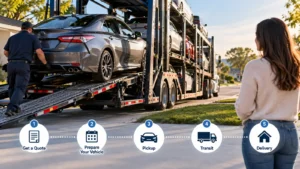
Once the vehicle clears customs at the port, ShipYourCarNow handles door-to-door domestic transport from any US port to your home. Open and enclosed auto transport options are available depending on your vehicle’s value and your preference.
Customs Clearance and Documentation
Customs clearance is the step most people worry about most. With the right documentation, it moves quickly. Missing documents causes delays that can cost hundreds of dollars in port storage fees.
Documents You Need
- ✓ Vehicle title proving ownership
- ✓ Bill of sale showing the price paid
- ✓ Foreign registration document
- ✓ EPA compliance form (3520-1)
- ✓ DOT compliance form (HS-7)
- ✓ Bill of lading from the shipping company
- ✓ Customs Form 7501 (entry summary)
- ✓ Certification label details from original manufacturer (if applicable)
- ✓ Proof of insurance
A licensed customs broker handles the clearance paperwork on your behalf and ensures forms submit correctly to US Customs and Border Protection. For first-time importers especially, the $200 to $500 broker fee is worth every dollar.
Registration, Sales Tax, and License Plates
Once your vehicle clears customs and arrives at its destination, registration at your local DMV finalises the process. Requirements vary by state, so check your specific state before you start.
- • Proof of ownership (title or Customs Form 7501)
- • Proof of insurance active on the vehicle
- • Emissions and safety inspection certificates (state-dependent)
- • Odometer disclosure statement
- • Payment of applicable state registration fees
- • License plates issued at time of registration
Sales Tax
Sales tax on imported vehicles works differently from a standard domestic purchase. In most states, sales tax applies at the time of registration based on the vehicle’s declared value. If you purchased the vehicle overseas and paid import duties, credit may apply. Check with your state DMV and a tax professional before assuming what you owe.
Red Flags and Due Diligence When Buying Overseas
International purchases carry risks that domestic transactions do not. Once money leaves your account via wire transfer, recovering it from a fraudulent seller in another country is difficult at best.
- ✓ Research the seller’s reviews and ratings thoroughly
- ✓ Get a third-party inspection from an independent inspector before any money changes hands
- ✓ Verify the vehicle history report for accidents and ownership records
- ✓ Purchase through established international dealers where possible
- ✓ Use bank wire transfer with documentation at every step
- ✓ Confirm the vehicle meets US standards before the purchase closes
- ✓ Keep copies of every document at every stage
- ✗ Rushing under pressure from a seller with time-limited offers
- ✗ Skipping the independent inspection to save money
- ✗ Paying by cash, cryptocurrency, or any method without a paper trail
- ✗ Ignoring evasive answers about vehicle history or documentation
- ✗ Forgetting additional costs — duties, compliance, freight, and registration add up fast
- ✗ Using an unregistered importer for compliance modifications
- ✗ Assuming your home state requirements match federal compliance standards
Ready to Ship Your Overseas Purchase Home?
ShipYourCarNow coordinates international vehicle shipping and domestic delivery from any US port to your door. Military members, civilian employees, car collectors, and international buyers — the team handles every step of the transport side so you can focus on the purchase.
Frequently Asked Questions
Is it cheaper to buy a car overseas and import it?
It can be significantly cheaper. European luxury vehicles like Mercedes-Benz and BMW often cost 15 to 25% less in their home countries. Classic Japanese sports cars frequently sell for half the US price in Japan. Even after import duties, ocean freight, compliance costs, and domestic delivery, the total price paid often beats what US dealers charge for the same vehicle.
What is the 25-year rule for importing cars?
Under the Motor Vehicle Safety Act, vehicles that reach 25 years from their original model year become exempt from EPA emissions standards and DOT Federal Motor Vehicle Safety Standards. A nonconforming vehicle that would otherwise require expensive compliance modifications can enter the US freely once it crosses that age threshold. Import duties still apply.
Can military members buy cars overseas and ship them home?
Yes. Military members and civilian employees stationed overseas have access to Military AutoSource, the only DoD-authorized car-buying program, with factory-direct pricing and more than 80 locations worldwide. Members can also purchase from local dealers and ship home through standard import channels. ShipYourCarNow works directly with military members returning stateside to coordinate the full transport and delivery process.
What documentation does my vehicle need to clear US customs?
The core documents are the vehicle title, bill of sale, foreign registration, bill of lading, EPA compliance form 3520-1, DOT compliance form HS-7, and the customs entry summary. A certification label affixed by the original manufacturer confirming compliance with safety requirements helps significantly. A licensed customs broker can handle the submission process and flag any missing paperwork before it causes delays.
What is a Registered Importer and do I need one?
A Registered Importer (RI) is a company certified by NHTSA to modify nonconforming vehicles so they meet US DOT safety standards. You need one if your vehicle does not carry a certification label from the original manufacturer confirming it already meets Federal Motor Vehicle Safety Standards. Always use an RI from the official NHTSA list — using an unregistered operator creates legal issues that attach to the vehicle’s title permanently.
What is the difference between RoRo and container shipping?
Roll-On Roll-Off (RoRo) means the vehicle drives directly onto the vessel deck. It costs 15 to 30% less than container shipping and offers faster loading and more frequent sailings. Container shipping places the vehicle inside a sealed metal container that provides maximum protection from weather, salt spray, and visibility. Container is the preferred choice for classic cars, high-value vehicles, and any situation where you want to include personal belongings inside the car during ocean transit.
Can a foreign national buy a car in the US and ship it home?
Yes. US dealerships sell to international buyers regularly. Payment by bank wire transfer is standard. If the vehicle ships out of state before registration, sales tax generally does not apply at the point of purchase. The title releases once all funds clear — allow up to 21 days. You are responsible for your destination country’s import duties, tariffs, and registration requirements, which vary significantly by country.
What are import duties on cars coming into the US?
Import duties on passenger cars run at 2.5% of the vehicle’s declared value. [source] Light duty trucks face a significantly higher rate of 25%. Additional fees include the Merchandise Processing Fee, Harbor Maintenance Fee, and customs processing charges totalling $300 to $500. These apply on top of the purchase price regardless of the vehicle’s age, with the exception of vehicles brought in under certain trade agreements.
How long does it take to import a car from overseas?
Ocean freight typically takes two to four weeks depending on origin. Add customs clearance time of one to five business days with proper documentation. Compliance modifications, if needed, can add several weeks. Budget six to ten weeks from purchase to delivery at your door for a smooth import. Delays most commonly come from missing documentation or compliance issues discovered at the port.
Ocean Freight FAQ
How long does ocean freight take when shipping a car?
Transit times vary by origin and destination port. From Europe to the US east coast, expect two to four weeks. From Japan or South Korea to the US west coast, allow two to three weeks. From Australia, budget four to six weeks. These are vessel transit times only and do not include customs clearance or domestic delivery at the destination.
How much does ocean freight cost for a car?
RoRo shipping typically starts around $1,500 from Europe and $1,000 to $1,500 from Japan or South Korea to the US west coast. Container shipping runs higher — shared containers start around $2,500 and exclusive containers can reach $4,000 or more depending on origin. West coast to east coast routing on the same vessel adds cost and time.
What is RoRo shipping and is it safe?
Roll-On Roll-Off means the vehicle drives directly onto the vessel under its own power and parks on the deck for the duration of the voyage. It is the standard method used by car manufacturers to ship new vehicles between continents. Hundreds of thousands of vehicles move this way every year. The main downside is exposure to sea air and salt spray, which is why enclosed container shipping is preferred for classic cars and high-value vehicles.
Can I track my car during ocean freight?
Yes. Most ocean freight providers offer vessel tracking through a booking reference number. You can monitor which port the vessel is in and get an estimated arrival date. Updates are not always real-time — vessel positions typically update every 12 to 24 hours. Your shipping coordinator can provide more detailed status updates during transit.
Does my car need insurance during ocean freight?
The shipping line carries basic liability, but it covers very little in the event of damage. Marine insurance is strongly recommended for any vehicle crossing an ocean. All-risk comprehensive coverage protects against damage during loading, unloading, and transit. For high-value vehicles, full replacement value coverage rather than depreciated value is worth the additional premium. Budget one to two percent of the vehicle’s value for marine insurance.
How do I prepare my car for ocean freight and how to make sure my vehicle complies?
For RoRo, the vehicle must be in running condition, have at least a quarter tank of fuel, carry no personal belongings, and have the battery charged and tires properly inflated. For container shipping, the same rules apply but personal belongings may be permitted inside the vehicle depending on the destination country’s customs rules. Document the car’s condition with photographs from every angle before it goes to the port.
What happens when my car arrives at the US port?
The vessel docks and the vehicle is offloaded either by driving it off the vessel deck (RoRo) or by crane-lifting the container. The vehicle then moves to a port holding area while customs clearance processes. Once cleared, it can be collected in person or handed to a domestic transport carrier for door-to-door delivery. Port storage fees apply if the vehicle sits uncollected beyond a grace period, typically three to five days.
Can I put personal items in my car during ocean freight?
For RoRo shipments, no. Personal belongings are not permitted on RoRo vessels under any circumstances. For container shipments, it depends on the destination country’s customs rules. Importing into the US, for example, does not permit personal belongings inside the vehicle. Items found inside at the port can result in fines, seizure, or shipment rejection. Always confirm the rules with your freight coordinator before loading anything inside the vehicle.
What is a bill of lading and why do I need it for?
A bill of lading is the official receipt issued by the shipping line confirming they have taken custody of your vehicle for transport. It lists the origin port, destination port, vessel name, and vehicle details. You cannot clear customs without it. Keep the original bill of lading safe — losing it creates significant delays at the destination port and can require a letter of indemnity from your bank to release the vehicle.
For more on the domestic transport side of the process, the ShipYourCarNow shipping process guide covers how door-to-door delivery works from any US port to your home. The car shipping costs guide breaks down domestic transport pricing so you can factor that into your total budget.
If you bought a car online domestically and need it shipped, the guide to shipping cars bought online covers that process in full. And for military members specifically, the military car shipping page covers benefits, documentation, and how ShipYourCarNow supports service members through every stage of the process.
Buying a car overseas and importing it takes planning, proper documentation, and the right shipping partner — but for the right vehicle, it remains one of the most effective ways to access motor vehicles that simply do not exist in the US market at any price.

Senior automotive logistics professional with a passion for the industry and a 10+ year history of accomplishments. Proven track record of exemplary client management working with both RMCs, Van Lines and OEMs. Keen ability to react to an ever-changing marketplace while offering superior technology solutions, programs and services. Architect of award winning auto transport portal technology offering transparency and agility to clients, agents and transferees. Successful team builder and leader easily managing budgets with effective leadership, strategic planning, and problem-solving capabilities.