
Quick Answer
ATV shipping works much the same way car shipping does, except the trailer, the tie-down points, and the loading equipment all change to suit a machine that sits lower, wider, and lighter than a sedan. Most owners pay somewhere between a few hundred dollars for a short regional move and climbs toward a couple thousand for a coast-to-coast run on an enclosed trailer. The three things that move that number most are distance, whether you choose open or enclosed transport, and the season you book in.
Anyone pricing all-terrain vehicle (ATV) shipping for the first time runs into the same wall: five quotes, five different numbers, and no clear reason why. We have moved quads, side-by-sides, golf carts, jet skis, and snowmobiles across 48 neighboring states, and the gap between those quotes almost always comes down to a handful of details nobody explained to you. This guide walks through every one of them, so you know what you are paying for before you book.
What You Should Know Before You Start
Do I need a special carrier for powersports, or will any auto transporter do?
- Many auto transport companies will quote your ATV, but far fewer own the right equipment for it.
- A specialized powersports carrier brings ramps, lower deck heights, soft tie-down straps, and wheel chocks sized for a quad rather than a car tire.
- Machines strapped down with car equipment can shift in transit, which puts stress on suspension and bodywork.
- Ask any carrier what they use to secure the unit before you accept a price.
Should I choose open or enclosed transport?
- Open transport costs less and suits work machines, utility quads, and anything already weathered.
- Enclosed transport shields the unit from weather conditions and road debris, which matters for show machines, new units, and custom paint.
- Open trailer transport remains the most common method for ATV shipping nationwide.
- If the value of the machine would make a scratch genuinely painful, pay for the extra protection.
How far ahead should I book?
- Two to three weeks gives you real choice of carriers and better pricing.
- Peak demand for ATV shipping typically runs from May through August, when riding season opens, and carrier availability tightens.
- Snowmobile shipping follows the opposite curve, with the heaviest volume heading north and into mountain states before winter.
- Last-minute bookings still move, though you will pay for the urgency.
Does my machine need to run?
- Non-running ATVs ship every day, and they cost more.
- A unit that will not start, steer, or brake needs a winch and sometimes a lift gate, which means special equipment and a longer loading window.
- Tell the carrier upfront. A surprise at pickup is the fastest way to lose your slot and your price.
What paperwork actually matters?
- The Bill of Lading governs everything. It records the condition of your machine at pickup and again at delivery.
- Accurate documentation on the Bill of Lading drives any insurance claim you might need to file later.
- Photographs of the ATV’s condition should be taken before shipping, from every angle, with timestamps.
- Read it before you sign it, both times.
0.50%
Industry average damage rate for transported freight
2.1M+
Motor carriers registered with the FMCSA
May to Aug
Peak demand window for ATV shipping
$100,000
Minimum cargo insurance carried by every carrier we dispatch
Sources: ShipYourCarNow 2026 U.S. Car Shipping Industry Report. FMCSA Registration Statistics
In this guide
- What ATV Shipping Covers and Which Machines Actually Qualify
- Open or Enclosed Transport: Which One Your Machine Really Needs
- ATV Shipping Costs and the Key Factors That Influence Pricing
- Door-to-Door or Terminal-to-Terminal Shipping for Powersports
- Golf Cart Shipping, Jet Ski Shipping, and Snowmobile Shipping
- Motorcycle Shipping Costs and How Powersports Rates Compare
- Insurance Coverage and Why the Bill of Lading Protects You
- How to Prepare Your ATV or Cart Before the Carrier Arrives
- Why Choose ShipYourCarNow for ATV Shipping Services and Powersports
- FAQ
What ATV Shipping Covers and Which Machines Actually Qualify
Powersports covers a wide family of machines, and carriers treat each one differently. A 400cc utility quad, a four-seat side-by-side, a lifted golf cart, a pair of jet skis on a shared trailer, and a long-track mountain sled all load differently and take up different amounts of deck space.
ATVs and larger Utility Terrain Vehicles (UTVs) vary widely in dimensions, which changes the transport options available to you. A single quad might ride alongside cars on a standard open carrier. A wide side-by-side with a roll cage often needs a flatbed trailer or a dedicated powersports hauler with the deck height to clear it.
What we move under this category:
✓
ATVs, quads, and four-wheelers, both sport and utility
✓
UTVs and side-by-sides, including crew-cab configurations
✓
Golf carts, street-legal and course-only
✓
Jet skis and personal watercraft, on their own trailer or off it
✓
Snowmobiles, single units and multi-sled loads
✓
Dirt bikes and small-displacement machines, often as part of a mixed load
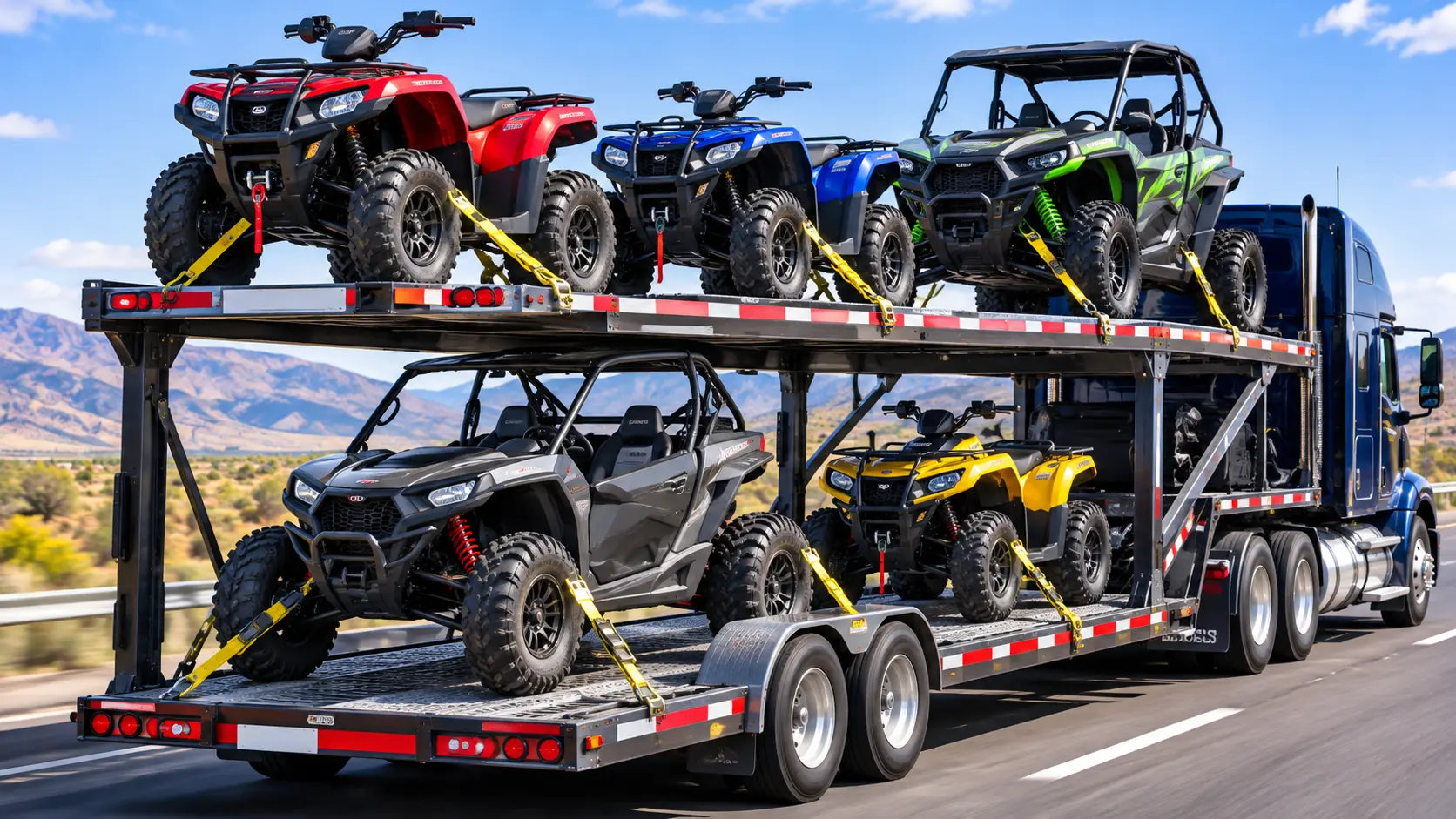
Before anything gets booked, a carrier runs an assessment. ATV assessments include verifying dimensions, weight, and modifications. A lift kit, oversized tires, a snow plow attachment, or an aftermarket cage can all change which trailer fits and what the move costs. Give those details at quote time, and the price you see holds.
Good to Know: Measure your machine before you request quotes. Length, width, and height at the tallest point, plus an honest weight. Guessing here creates the single most common reason a powersports quote gets revised after booking.
Open or Enclosed Transport: Which One Your Machine Really Needs
This decision drives more of your final price than any other choice you control. Open transport puts your machine on an uncovered trailer, exposed to the same conditions it would meet on a trail ride. Enclosed shipping puts it inside a sealed trailer where nothing reaches it.
Open transport exposes ATVs to potential weather damage and road debris. For a mud-caked work quad, that hardly registers. For a restored vintage sled or a cart with custom wrap, it matters a great deal.
When to choose open transport:
When to pay for enclosed transport:
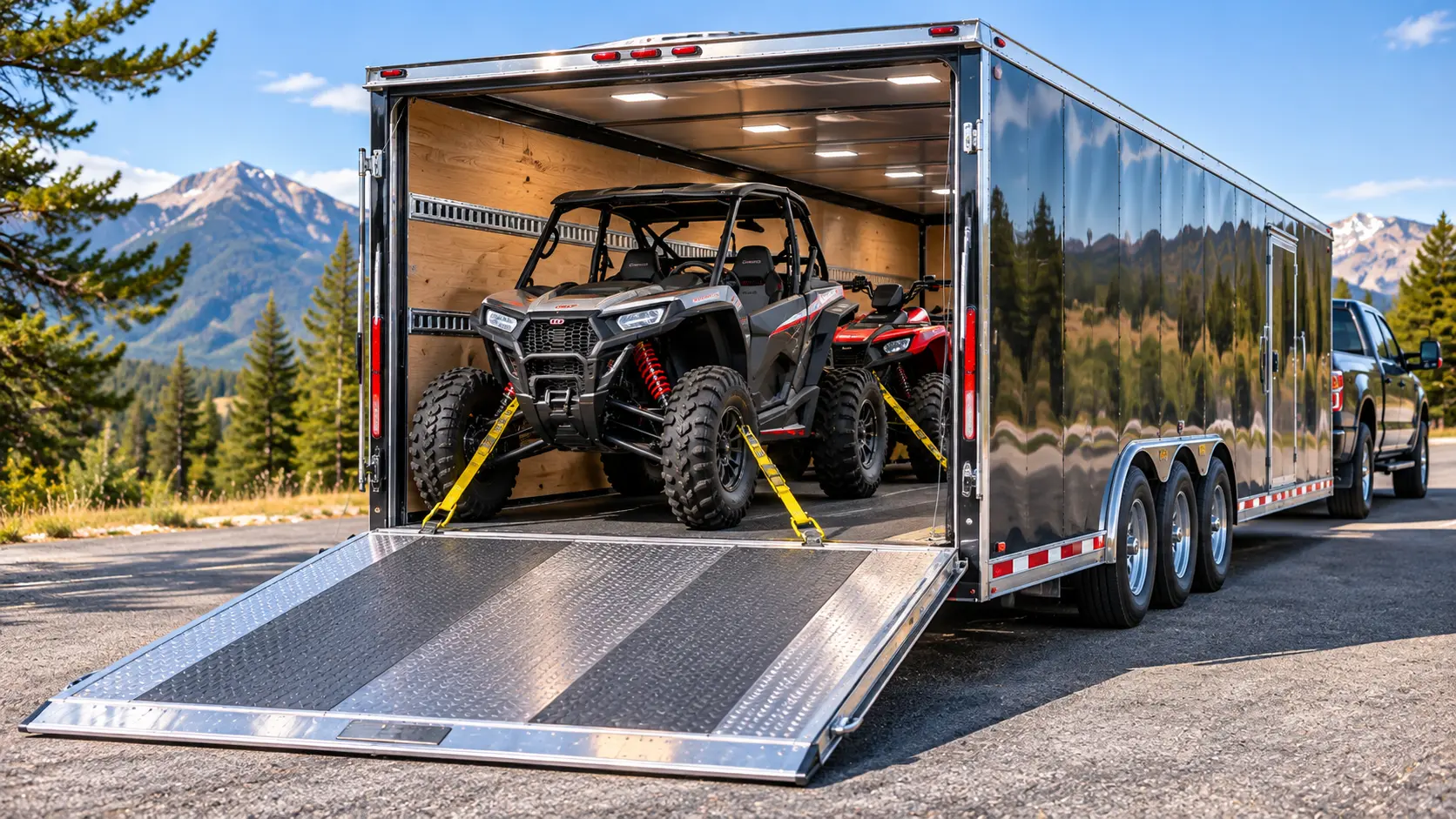
Enclosed trailers typically add 30% to the quote, and the gap narrows on longer distances. Our own 2026 industry data puts enclosed carriers at roughly $2.10 to $2.50 per mile under 500 miles, closing to around $0.48 to $0.70 per mile beyond 2,500 miles. The same curve applies to powersports loads. If you want the full breakdown of the math behind a quote, our guide to how car shipping costs are calculated covers it in detail. You can also compare open car shipping against enclosed car shipping side by side.
ATV Shipping Costs and the Key Factors That Influence Pricing
ATV shipping costs vary by distance, season, and vehicle size, and every quote you receive reflects a carrier’s read on those three things plus their own route economics.
Here are the key factors that influence pricing on a powersports move:
Distance.
Longer distances raise the total while lowering the rate per mile. Short distances carry a higher per-mile cost because loading time stays the same no matter how far the truck drives.
Transport type.
Open transport, enclosed shipping, Less-Than-Truckload (LTL) freight, and crated freight shipping all price differently. Crated freight shipping is often used for long-distance ATV transport where no powersports carrier runs the lane.
Size and weight.
A full-size four-seat UTV occupies the space of a small car. Carriers price by the room you take and the weight you add.
Running condition.
Non-running ATVs may incur additional fees because loading requires a winch or lift gate.
Pickup and delivery access.
Transport costs can increase when a truck cannot reach your address. Narrow rural roads, low branches, and gated communities all force a meeting point.
Season.
Peak seasons tighten carrier availability and push prices up. Seasonal demand affects powersports pricing as sharply as it does cars.
Fuel prices.
Diesel moves the market. When fuel prices climb, carriers raise rates across every lane.
Distance and location affect ATV shipping costs most sharply in remote areas. A pickup two hours off the interstate costs more than one in a metro area, because the carrier burns hours and fuel reaching you.
Watch Out: Shipping quotes often vary significantly based on route, carrier, and cargo details, and the lowest number on your screen is not always a real price. Some transport companies post a low figure to win the booking, then raise it once no carrier accepts the load. Ask whether the quote is locked before you hand over a deposit.

“You could always go online and find transport for less money, but what is really the cost of that $50 savings? What is the risk that you’re opening yourself up to?”
Marco Maggiore, Chief Strategy Officer, ShipYourCarNow | LinkedIn
Door-to-Door or Terminal-to-Terminal Shipping for Powersports
Two delivery models exist, and the right one depends on how much your time costs you.
Door-to-door shipping brings the truck as close to your address as the law and the street allow. Door-to-door service saves time by eliminating terminal visits, and for most powersports owners it wins on convenience alone. You meet the driver, you inspect the machine, you sign, and you are done.
Terminal-to-terminal shipping requires pickup and drop-off at designated terminal locations. You drive to a secure yard, hand over the unit, and collect it from another yard at the far end. Terminal-to-terminal shipping is typically less expensive than door-to-door, and the savings grow on long hauls.
Where each option makes sense:
Door-to-door auto transport:
Best when you cannot take a day off, when the machine does not run, or when no terminal sits within reasonable driving distance.
Terminal-to-terminal shipping:
Best when a terminal sits near both ends, when your schedule flexes, and when the lower overall cost outweighs the extra driving.
One caution on terminals. Your machine may sit in storage for several days at either end, and outdoor yards expose it to weather. Ask about covered storage before you choose the cheaper route. You can read more on door-to-door auto transport and on terminal-to-terminal auto shipping to compare the two properly.
If timing drives your decision rather than price, expedited car shipping narrows the pickup window at a premium.
Golf Cart Shipping, Jet Ski Shipping, and Snowmobile Shipping
Each of these three loads behaves differently on a trailer, and each one catches first-time shippers out in its own way.
Golf cart shipping
A golf cart rolls easily, which makes loading simple, and sits low, which makes tie-down placement awkward. Most carts travel on an open trailer or a flatbed trailer, strapped at the frame rather than the suspension. Lithium and lead-acid batteries both need disconnecting or securing before transport, and the carrier will ask. Community-to-community moves in Florida and Arizona make up a large share of our golf cart volume, particularly during snowbird season.
Jet ski shipping
Personal watercraft ship either on their own trailer or lifted onto a carrier deck. Shipping on the trailer usually costs less because loading takes minutes. Drain the hull, remove loose accessories, and secure the cover so it does not shred at highway speed. Anything that can flap will flap.
Snowmobile shipping
Sleds ship year-round, with volume peaking before the first snow in the northern states and Mountain West. Track and skis need protection from pavement contact, so carriers use a pallet or a cradle. Multi-sled shipments on a single trailer bring the per-unit cost down sharply, which makes group bookings worth organizing with riding partners.
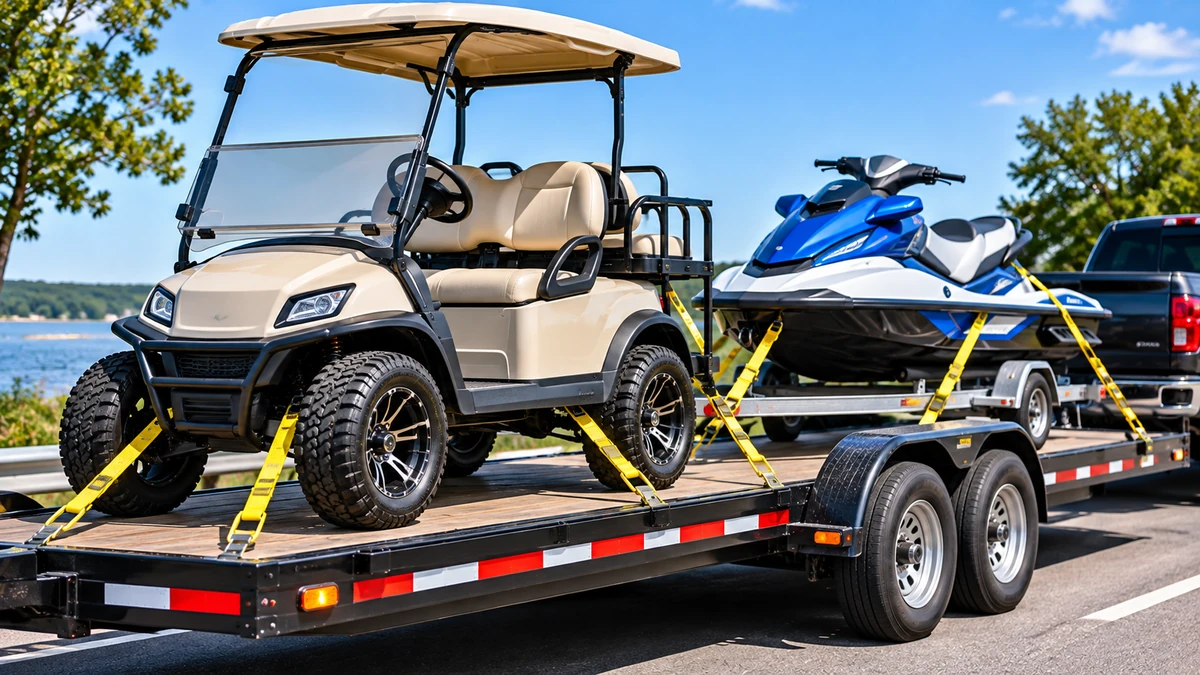
💡 Pro Tip: Shipping two or more units together almost always beats two separate bookings. Carriers price by the space you occupy, and a second machine on the same load adds far less than a second pickup does.
For watercraft on larger trailers, our boat shipping services page covers the heavier end of the range.
Motorcycle Shipping Costs and How Powersports Rates Compare
Owners researching ATV shipping often price motorcycle shipping at the same time, and the two markets track each other closely enough to be useful as a benchmark.
Motorcycle shipping costs generally run from around $300 for a short regional move to roughly $1,200 for a long cross-country haul, with the average cross-country figure landing near $600 to $800. Powersports units tend to price slightly above comparable motorcycle shipping because they take more deck space and need more securing points.
The same forces drive both:
Our motorcycle shipping services page covers the handling that bikes need, and the process itself mirrors what we describe in how the car shipping process works.
“Whether you’re shipping your mom’s 2001 Toyota Camry or a new Bugatti rolling off the block, we can handle both with the same level of security, service, and care.”
Marco Maggiore, Chief Strategy Officer, ShipYourCarNow | LinkedIn
Insurance Coverage and Why the Bill of Lading Protects You
Insurance coverage sits at the center of every vehicle shipping decision, and it causes more confusion than any other part of the process.
Good to Know: Most carriers provide basic insurance coverage during transport, but the Federal Motor Carrier Safety Administration (FMCSA) doesn’t require cargo insurance for carriers moving ATVs. Federal rules require cargo coverage only for household goods movers.
That leaves the amount of cargo coverage up to each operator, and it varies widely, which is exactly why the number matters. ShipYourCarNow makes cargo insurance a condition of every booking. Every carrier we dispatch holds a minimum of $1,000,000 in liability insurance and $100,000 in cargo insurance, verified before the load is assigned.
Additional coverage may be necessary for high-value machines. A limited-edition sled, a fully built side-by-side, or a cart with five figures of custom work can exceed a standard cargo policy, and a rider closes that gap. Ask for the carrier’s certificate of insurance and check the cargo limit against what your machine would cost to replace.
What to confirm before you book:
The cargo insurance limit in dollars, not a vague assurance of coverage.
Whether aftermarket parts and accessories fall inside or outside the policy.
Who handles a claim: the broker or a third party.
How damage gets documented at delivery.
The damage rate across the industry sits at roughly 0.50%, according to our 2026 U.S. Car Shipping Industry Report. Claims stay rare, and the owners who struggle are almost always the ones who skipped documentation at pickup. Documenting your machine’s condition before shipping protects you more than any policy clause does.
Our guides to understanding auto transport insurance and what a Bill of Lading covers go deeper on both.
How to Prepare Your ATV or Cart Before the Carrier Arrives
Preparation for ATV shipping requires cleaning, documenting damage, and securing accessories. Thirty minutes of work here prevents most of the problems that show up at delivery.
Work through this before pickup day:
Wash it. Clean paint reveals existing damage. Mud hides it, and hidden damage becomes disputed damage.
Photograph everything. Wide shots and close-ups, with the date visible.
Remove loose accessories. Mirrors, antennas, soft bags, GPS units, plow blades, and windshields that unclip. Loose accessories become projectiles at highway speed.
Secure or disconnect the battery. Confirm the carrier’s preference, since practice varies by equipment.
Lower the fuel level. A quarter tank or less reduces weight and spill risk.
Check for leaks. Active leaks get a unit refused at pickup.
Fold or remove mirrors and windshields on carts and side-by-sides.
Leave the keys available so the driver can roll and steer the machine during loading.
💡 Pro Tip: Shoot a slow walk-around video on your phone at pickup with the driver present, then another at delivery. Two minutes of footage settles a disagreement faster than a dozen still photos.
Why Choose ShipYourCarNow for ATV Shipping Services and Powersports
Powersports owners come to us because the machine matters to them, and because the transport companies they tried first treated it as freight rather than as something someone built, rode, and cared for.
ShipYourCarNow has more than 20 years in the auto transport industry, FMCSA licensing, and BBB accreditation. We built our carrier network around the idea that the people who haul your machine should be as accountable as the people who booked the job. More than 2.1 million motor carriers hold FMCSA registration, and the gap between the best and the worst of them is enormous. Vetting is the whole job.
What that looks like in practice at ShipYourCarNow:
We also handle the moves that sit either side of powersports, including military vehicle shipping for PCS orders and snowbird car shipping for seasonal residents who bring the cart and the car south together.
Call us at (866) 390-0354 or get an instant car shipping quote online.
“On the day of pickup, you will receive a text message from us which will contain a link showing you the driver’s license and photo information of the assigned driver, as well as confirmation of the type of equipment showing up to pick up your vehicle.”
Marco Maggiore, Chief Strategy Officer, ShipYourCarNow | LinkedIn
Ready to move your machine?
Tell us what you ride, where it starts, and where it needs to go. You get a locked-in price, a vetted carrier, and a coordinator who stays with the order until the unit rolls off the trailer.
FAQS
Most ATV shipping lands between roughly $200 and $600 for regional moves and climbs toward $1,500 or more for enclosed coast-to-coast transport. Distance drives the biggest share of that, followed by transport type and the size of the machine. A single utility quad on an open trailer sits at the low end. A four-seat side-by-side in an enclosed trailer during summer sits at the high end. Request a quote with exact dimensions, and you get a number you can plan around.
Transit time tracks distance closely. Regional moves under 800 miles usually complete within one to four days of pickup. Cross-country runs typically take 7 to 14 days. Pickup itself generally happens within one to three days of booking, though peak seasons stretch that window. We give estimated ranges rather than fixed dates, because weather conditions, road closures, and hours-of-service rules all affect a driver’s schedule.
Yes, and it almost always costs less per unit than booking separately. Carriers price by the deck space you occupy, so a second or third machine on the same load adds much less than a second pickup would. Multi-unit shipments work especially well for clubs, dealerships, and families moving a fleet of carts or sleds. Give us the full inventory with dimensions, and we match you to a carrier with the right trailer.
No. Non-running machines ship regularly, and they cost more because loading requires a winch and sometimes a lift gate. The important distinction is whether the unit rolls, steers, and brakes. A machine that does all three loads far more easily than one that does none. Declare the condition when you request the quote, because a surprise at pickup can cost you the slot.
Every carrier we assign holds a minimum of $1,000,000 in liability insurance and $100,000 in cargo insurance, verified before dispatch. That cargo limit covers most powersports machines comfortably. High-value units, heavily modified builds, and collector sleds sometimes warrant additional coverage, and we will tell you when we think that applies. Ask for the certificate of insurance and read the cargo limit for yourself.
For a brand-new unit still carrying factory finish, enclosed transport earns its premium. Open trailers expose the machine to weather conditions, road grit, and debris thrown by passing traffic across the whole route. On a short regional hop, that exposure stays minimal and open transport makes sense. On a 2,000-mile run through multiple weather systems, the extra protection usually proves worth it.
Open transport on a terminal-to-terminal basis, booked outside peak season, with flexible pickup dates. Combining units on one load lowers it further. Towing it yourself can look cheaper on paper, though fuel prices, trailer rental, hotels, and the wear on your tow vehicle often close the gap. Run both numbers before you decide.
Standard road transport rarely requires draining fluids, and most carriers simply ask for a low fuel level. Crated freight shipping is different, and crating generally requires draining fluids and disconnecting the battery before the unit is sealed. Confirm with your carrier, because requirements shift between open, enclosed, and freight methods.
Spring and early fall usually give the best combination of price and carrier availability. Peak demand for ATV shipping runs from May through August, when riding season opens, and prices climb with it. Snowmobile shipping peaks in the opposite direction, ahead of winter in northern and mountain states. Booking two to three weeks out protects you in either season.
Note the damage on the Bill of Lading before you sign at delivery, photograph it immediately, and contact us the same day. Our claims team works in-house rather than through a third party, which keeps the process moving. Claims remain uncommon across the industry, and accurate documentation at both ends of the journey is what makes the difference when one is filed.
Whether you ride a quad, drive a cart, or tow a pair of sleds every winter, ATV shipping should feel straightforward from the first quote to the final signature, and that is exactly what we built our powersports transport around.

Senior automotive logistics professional with a passion for the industry and a 10+ year history of accomplishments. Proven track record of exemplary client management working with both RMCs, Van Lines and OEMs. Keen ability to react to an ever-changing marketplace while offering superior technology solutions, programs and services. Architect of award winning auto transport portal technology offering transparency and agility to clients, agents and transferees. Successful team builder and leader easily managing budgets with effective leadership, strategic planning, and problem-solving capabilities.