
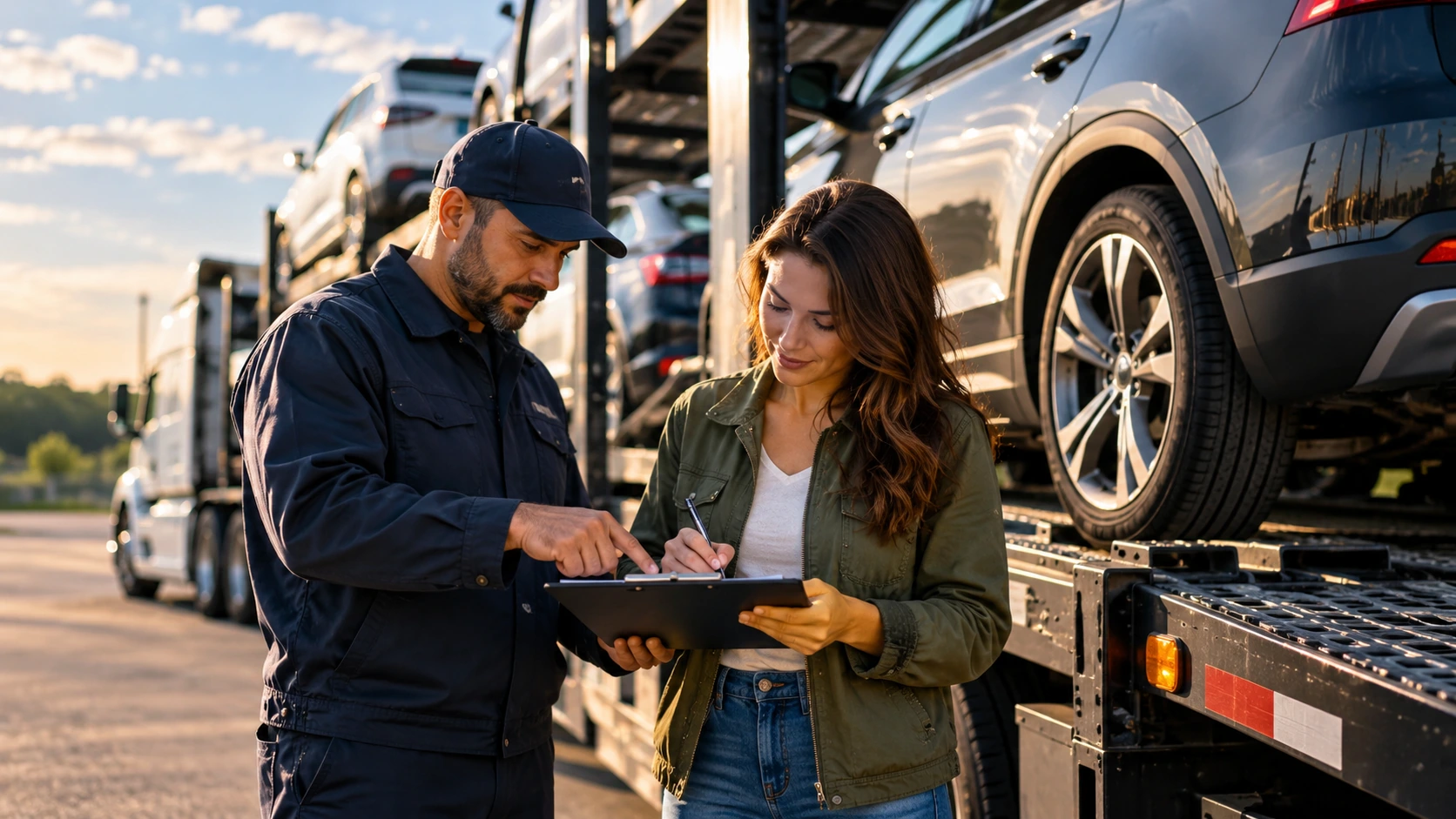
A bill of lading is the one legal document that records what condition your vehicle was in when the driver loaded it and what condition it arrived in. You sign it twice, once at pickup and once at delivery, and those two signatures decide whether a damage claim later succeeds or is denied. Read every line before you sign, confirm the vehicle identification number matches your title, and never accept delivery until you have walked around the entire car.
A bill of lading (BOL) works as your receipt, contract, and proof of condition all at once, making it the most important piece of paper in any car shipping transaction. Most first-time shippers sign it in about eleven seconds while the driver waits, and that habit costs people thousands of dollars every year. Before you get an instant car shipping quote, spend five minutes learning what the form actually says.
What You Should Know About the Bill of Lading Before You Start
Who creates the bill of lading?
- The carrier moving your vehicle issues the form, not the broker who booked your order.
- Your driver arrives with a printed pad or a tablet loaded with a digital version.
- You never need to supply your own lading template or download an existing bill of lading form.
- Both you and the driver keep a copy once you sign.
How many times will I sign it?
- Twice. Once at pickup, and again at delivery.
- The pickup signature confirms the vehicle’s condition before loading.
- The delivery signature confirms the condition after transport and closes the shipment.
- Both the shipper and the carrier must sign at each end for the document to hold up.
What makes this document different from my booking confirmation?
- Your booking confirmation covers price, dates, and payment terms with the broker.
- The BOL serves as the contract of carriage between you and the motor carrier hauling the car.
- Only the BOL carries the condition report, which no booking confirmation includes.
- Keep both. Insurance adjusters ask for the BOL first.
What happens if I sign without inspecting?
- A clean signature at delivery tells the carrier’s insurance company the car arrived undamaged.
- Damage caused in transit becomes extremely difficult to prove afterward.
- Photos taken later carry far less weight than notations made on the form itself at delivery.
- Ten minutes of inspection protects a vehicle worth tens of thousands of dollars.
- What a Bill of Lading Does in Car Shipping and Why It Matters
- Key Components of a Car Transport Bill of Lading Form Explained
- The Condition Report on Your Auto Transport Bill of Lading Form
- What to Check on the Bill of Lading Before You Sign at Pickup
- Delivery Locations, Final Inspection, and the Second Signature
- How a Damage Claim Runs on the Auto Transport Bill of Lading
- Types of Bills of Lading Used in Car Transport and Freight Bills
- Why Customs Needs the Bill of Lading on Overseas Car Shipping
What a Bill of Lading Does in Car Shipping and Why It Matters
The bill of lading (BOL) carries three jobs at once, and understanding all three explains why I tell every customer to slow down at the driver’s clipboard.
1
2
3
That third function surprises people. A piece of paper can move ownership of a vehicle across a port, which explains the strict handling rules that come with it.
Domestically, the first two functions matter most. The BOL acts as the legal document a court or an adjuster reads when two parties disagree about what happened to a car between Phoenix and Boston. Damage in transit remains rare. Our 2026 U.S. car shipping industry report puts the industry claims percentage for damaged freight at roughly 0.5%, which works out to about one claim in every two hundred shipments. What has changed is the cost when it does happen. The average estimate on a drivable front-end claim now reaches $3,706, a 39.4% jump since 2019, because a modern bumper carries sensors, cameras, and radar modules that a 2019 bumper never had. A scuff nobody wrote down at pickup can turn into a four-figure argument.
Source: ShipYourCarNow 2026 U.S. car shipping industry report

“They should be able to not only give you answers but show you tangibly what they’re doing to make sure that you’re confident when you’re shipping your vehicle with them.”
Marco Maggiore, Chief Strategy Officer, ShipYourCarNow | LinkedIn
Key Components of a Car Transport Bill of Lading Form Explained
Federal regulation sets a floor here. Under 49 CFR 373.101, every for-hire motor carrier operating in interstate commerce must issue a receipt or bill of lading showing the names of the consignor and consignee, the origin and destination points, the number of packages, a description of the freight, and the weight or measurement where it affects rating.
Auto transport goes well past that minimum. A working car transport bill covers these key components:
- Legal names, addresses, and phone numbers for both the shipper and the receiving party.
- Carrier details including the company name, USDOT number, and driver information.
- Vehicle details covering the year, make, model, color, and the full vehicle identification number (VIN).
- Pickup and delivery locations with dates and times recorded at each end.
- The condition report, usually a diagram of the car with damage codes marked on it.
- Payment terms, the balance due at delivery, and the accepted payment method.
- Shipment details such as whether the car ships on an open trailer or under enclosed cover.
- Signature lines for both you and the driver at pickup and again at delivery.
1
2
3
4
5
6
7
8
Bill of lading vs. freight bill
People mix these up constantly. The freight bill invoices you for the transport charges, while the BOL governs custody and condition of the vehicle. A carrier issues both documents, and you need them if a dispute ever reaches an insurance company.
- Governs custody and condition of the vehicle
- Issued by the carrier
- Holds the condition report
- Needed in an insurance dispute
- Invoices you for the transport charges
- Issued by the carrier
- No condition report
- Needed in an insurance dispute
The Condition Report on Your Auto Transport Bill of Lading Form
The condition report separates a vehicle BOL from a standard freight document. Freight rarely needs a drawing. A car does, because if a car arrives covered in small scratches, chips, and door dings, somebody has to account for it.
Your driver walks the vehicle and marks pre-existing damage on a diagram using a code key printed on the form. Common codes cover scratches, dents, chips, cracked glass, rust, and missing parts. Some carriers also record mileage and fuel level.
ScratchesDentsChipsCracked glassRustMissing parts
Some carriers also record mileage and fuel level. Code keys vary by carrier, so ask your driver to explain the key printed on your form.
This drawing becomes the baseline. Anything not marked at pickup gets treated as new damage if it shows up at delivery, which puts the burden squarely on the carrier. Anything marked at pickup belongs to you, which is why an overly generous driver marking phantom damage on a clean car should raise your eyebrows.
Three habits protect you here, and they double as your best defense if you ever need to avoid car shipping scams built around vague paperwork:
- Walk around the car with the driver rather than watching from the porch.
- Ask the driver to explain any code you don’t recognize before you sign.
- Take your own photos in daylight, close-up and wide, including the roof and wheels.
Whether you book open car shipping or enclosed car shipping for a collector vehicle, the inspection routine stays identical. Enclosed transport lowers road debris risk, though it never replaces a correctly documented condition report.
What to Check on the Bill of Lading Before You Sign at Pickup
Pickup day moves fast. Drivers run tight schedules, weather turns, and a neighbor wants to know why a car hauler blocks the street. None of that obligates you to rush.
That last line deserves attention. A quoted price that quietly grows between booking and pickup signals a company that treats your order as negotiable. Our fixed price promise exists precisely because the industry has trained customers to expect the opposite, and understanding how car shipping costs are calculated makes those surprises easy to spot.
Verify the person too, not just the paperwork. Freight fraud has moved into vehicle transport in a serious way. Supply chain security firm Overhaul logged 574 cargo theft incidents nationwide in the first quarter of 2026, and FreightWaves reported that deceptive pickup schemes using fake identities and forged credentials climbed 31% year over year.
Source: Overhaul data via FreightWaves
“On the day of pickup, you will receive a text message from us which will contain a link showing you the driver’s license and photo information of the assigned driver, as well as confirmation of the type of equipment showing up to pick up your vehicle.”
Marco Maggiore, Chief Strategy Officer, ShipYourCarNow | LinkedIn
Delivery Locations, Final Inspection, and the Second Signature
The delivery signature carries more legal weight than the one at pickup. Signing a clean delivery copy tells everyone downstream that the vehicle got delivered safely and the transport process ended without incident.
- Confirms the vehicle’s condition before loading
- Locks in the starting condition
- Both the shipper and the carrier sign
- Confirms the condition after transport
- Closes the shipment
- Carries more legal weight than the pickup signature
Our guide to car shipping pickup and delivery preparation covers the logistics. Work through the car before you sign:
- Inspect in good light, and ask the driver to wait if the truck arrives after dark.
- Compare the vehicle against the pickup diagram panel by panel.
- Check the roof, the lower rocker panels, and the wheels, where damage hides.
- Open and close the doors, hood, and trunk.
- Start the engine and confirm the electronics respond.
- Note anything new directly on the form before you sign, in writing, with the driver present.
1
2
3
4
5
If both parties agree on what happened, the driver signs the notation as well. If the driver disputes it, write your version anyway and photograph the annotated form. A noted disagreement beats no note at all.
Night deliveries create most of the arguments I see, which is why a coordinator who answers the phone at 9 p.m. matters more than any marketing promise.
“We stay with our customer throughout the entire transport. You’ll generally have an individual agent who’s there to assist you throughout the whole process and we’re committed to full transparency.”
Marco Maggiore, Chief Strategy Officer, ShipYourCarNow | LinkedIn
Our door-to-door auto transport coordinators schedule around that when a route allows, and customers who book expedited car shipping usually get tighter delivery windows to work with.
How a Damage Claim Runs on the Auto Transport Bill of Lading
Every damage claim starts with this document. The adjuster at the carrier’s insurance company compares the pickup diagram against the delivery notations, and the difference between them defines the claim.
Supporting documents strengthen your position: your own photos from both ends, the booking confirmation, repair estimates, and any text messages with the driver.
Federal rules set the clock. Under 49 U.S.C. 14706, a carrier can’t require you to file a claim in less than nine months from delivery, so any bill of lading form demanding a shorter window fails to hold up. Once you file, 49 CFR Part 370 requires the carrier to acknowledge your claim in writing within 30 days and to pay it, deny it, or make a firm settlement offer within 120 days.
1
2
3
4
Sources: 49 U.S.C. 14706 and 49 CFR Part 370
“We don’t outsource our claims. We have our own claims team in-house that works to resolve those issues quickly and without any additional stress or friction to our customer.”
Marco Maggiore, Chief Strategy Officer, ShipYourCarNow | LinkedIn
If a carrier or broker stonewalls you, the FMCSA runs a National Consumer Complaint Database that covers auto haulers alongside movers and bus lines. Complaints filed there enter the company’s permanent record and help the agency decide who to investigate.
“There’s nothing wrong with companies that require deposits, but you need to make sure they don’t stop once they’ve collected that deposit. They should be there with you for the whole duration of the transport.”
Marco Maggiore, Chief Strategy Officer, ShipYourCarNow | LinkedIn
Before you book anything, read up on auto transport insurance so you know which policy answers first when a claim lands.
Types of Bills of Lading Used in Car Transport and Freight Bills
Different types of bills of lading serve different functions based on negotiability, and the term you hear depends on where your car goes and who handles it.
| Type | Grouped By | What It Means |
|---|---|---|
| Straight | Negotiability | Non-negotiable, made out to a named consignee. Standard for domestic car transport. |
| Order | Negotiability | Negotiable, allowing ownership transfer by endorsement. Common in trade financing. |
| Bearer | Negotiability | Highly negotiable and released to whoever holds it. Rarely used today. |
| Clean | Condition | Signed with no damage noted during transport. |
| Claused or dirty | Condition | Notes visible damage or defects present before or at loading. |
| Original | Release | Must be physically presented before the carrier releases the cargo. |
| Surrendered | Release | Allows electronic release of goods without a paper copy changing hands. |
Heavy equipment, motorcycles, and boats travel under the same document family, with condition reporting adapted to the machine.
You don’t need a bill of lading template, because your carrier supplies the form. Search volume for a blank lading template runs high only because business shippers build their own, and a consumer shipping one car never does.
Digital signatures are equally valid, so when a driver captures yours on a tablet and emails the PDF, that electronic BOL carries the same legal force as ink on paper and gives you a timestamped, clear record that can’t fade in a glovebox.
Why Customs Needs the Bill of Lading on Overseas Car Shipping
Ship a car outside the country, and this document stops being paperwork and starts being the key to the vehicle. Government and customs authorities require the bill of lading to verify shipments, and without a properly prepared one, your cargo can’t clear customs smoothly.
Details on the BOL must match your supporting documents exactly. The VIN, year, make, and model need to agree with the title and the commercial invoice. A transposed digit between those three documents stalls a container at the port and racks up storage fees.
| Detail | Bill of Lading | Vehicle Title | Commercial Invoice |
|---|---|---|---|
| VIN | ✓ | ✓ | ✓ |
| Year | ✓ | ✓ | ✓ |
| Make | ✓ | ✓ | ✓ |
| Model | ✓ | ✓ | ✓ |
Overseas shipments also lean on the document of title function described earlier. The consignee presents the original bill of lading at the destination port to take release of the vehicle, which is why shippers guard those originals carefully and why surrendered BOL arrangements exist for parties who trust each other.
Domestic customers shipping between one location and another never touch customs, though the habit of matching every document against the title serves them just as well.
Why ShipYourCarNow Handles Auto Transport Paperwork Differently
I have spent more than 17 years in this industry, and almost every dispute I have watched unravel traces back to a condition report nobody read. So we built our process around the opposite habit.
“We treat every car that we ship as if it was our own personal vehicle. We want you to be comfortable, we want you to be educated, and we’re here to provide that for you.”
Marco Maggiore, Chief Strategy Officer, ShipYourCarNow | LinkedIn
Whether you handle a military vehicle shipping order for a PCS move, a seasonal snowbird car shipping run, or a classic and luxury car shipping job on an enclosed trailer, the same coordinator walks you through the form before the truck arrives. Reviewing how the car shipping process works and our guide to preparing your vehicle for shipping will have you ready on pickup day.
Get a free quote in minutes and talk to a coordinator who will walk you through every line of the form before your driver arrives.
or call 866 390-0354
Frequently Asked Questions
What is a bill of lading in car shipping?
It functions as a legal document that combines three roles: a receipt proving the carrier took your vehicle, a contractual agreement covering the transport, and a condition report recording the vehicle’s condition at both ends. Your driver issues it at pickup and closes it out at delivery. Insurance adjusters treat it as the primary evidence in any damage claim. Keep your copy until the car has sat in your driveway for a few weeks.
Who fills out the bill of lading, me or the driver?
The driver completes the form on behalf of the motor carrier moving your vehicle. You review the vehicle details, confirm the pickup and delivery locations, walk the car alongside the driver, and sign to confirm you agree with what has been recorded. Nothing stops you from asking for a correction before signing. A driver who resists a reasonable correction gives you a reason to call your coordinator.
Do I have to sign at both pickup and delivery?
Yes. Both the shipper and the carrier sign at pickup to lock in the starting condition, then sign again at delivery to record the ending condition. Skipping either signature weakens the document badly. If you can’t attend in person, appoint someone you trust and brief them on exactly what to inspect.
What happens if I sign and find damage later?
Damage discovered after a clean signature becomes hard to claim, because the signed form tells the carrier’s insurance company the vehicle arrived in the same condition it left. Report it to your coordinator immediately with dated photos anyway. Some cases still get resolved, particularly where damage sat hidden under road grime. The far better outcome comes from catching it during the delivery walkaround.
Is a digital bill of lading legally valid?
Yes. Digital signatures captured on a driver’s tablet carry the same legal weight as ink, and most carriers now email a PDF within minutes of each signature. Confirm the email arrives before the truck leaves. An electronic copy also timestamps itself, which helps considerably if anyone later disputes when the transfer happened.
Is the bill of lading the same as my booking contract?
No. Your booking contract sets price, service level, and payment terms with the broker who arranged the shipment. The BOL governs the transport portion and documents custody of the vehicle between you and the carrier. Both matter, and they cover different ground. File them together.
Can someone else sign for me?
Yes. You can authorize a friend, family member, or dealership contact to release or receive the vehicle. Give the carrier that person’s legal name and phone number in advance so it appears on the form. Brief them thoroughly, because their signature binds you exactly as your own would.
Do I need my own bill of lading form or template?
No. The carrier provides it. Blank templates and printable forms exist for businesses that ship freight regularly and need standardized paperwork across many carriers. A consumer shipping one vehicle never needs to prepare a bill of lading form.
How long do I have to file a damage claim?
Federal law bars carriers from requiring a written claim in less than nine months from the delivery date, so a term on the form demanding a shorter window won’t stand. File far sooner than that. Evidence goes stale, memories fade, and a claim filed within days carries far more credibility than one filed in month eight.
Does the bill of lading prove I own the car?
Not on a domestic move. Your title proves ownership, and the BOL simply documents custody during transport. On international shipments, the picture changes, since the BOL functions as a document of title and the rightful holder can claim the cargo or transfer ownership by endorsement.
Ship your car with a company that treats the bill of lading as your protection rather than a formality, and get an instant car shipping quote today.




Senior automotive logistics professional with a passion for the industry and a 10+ year history of accomplishments. Proven track record of exemplary client management working with both RMCs, Van Lines and OEMs. Keen ability to react to an ever-changing marketplace while offering superior technology solutions, programs and services. Architect of award winning auto transport portal technology offering transparency and agility to clients, agents and transferees. Successful team builder and leader easily managing budgets with effective leadership, strategic planning, and problem-solving capabilities.