
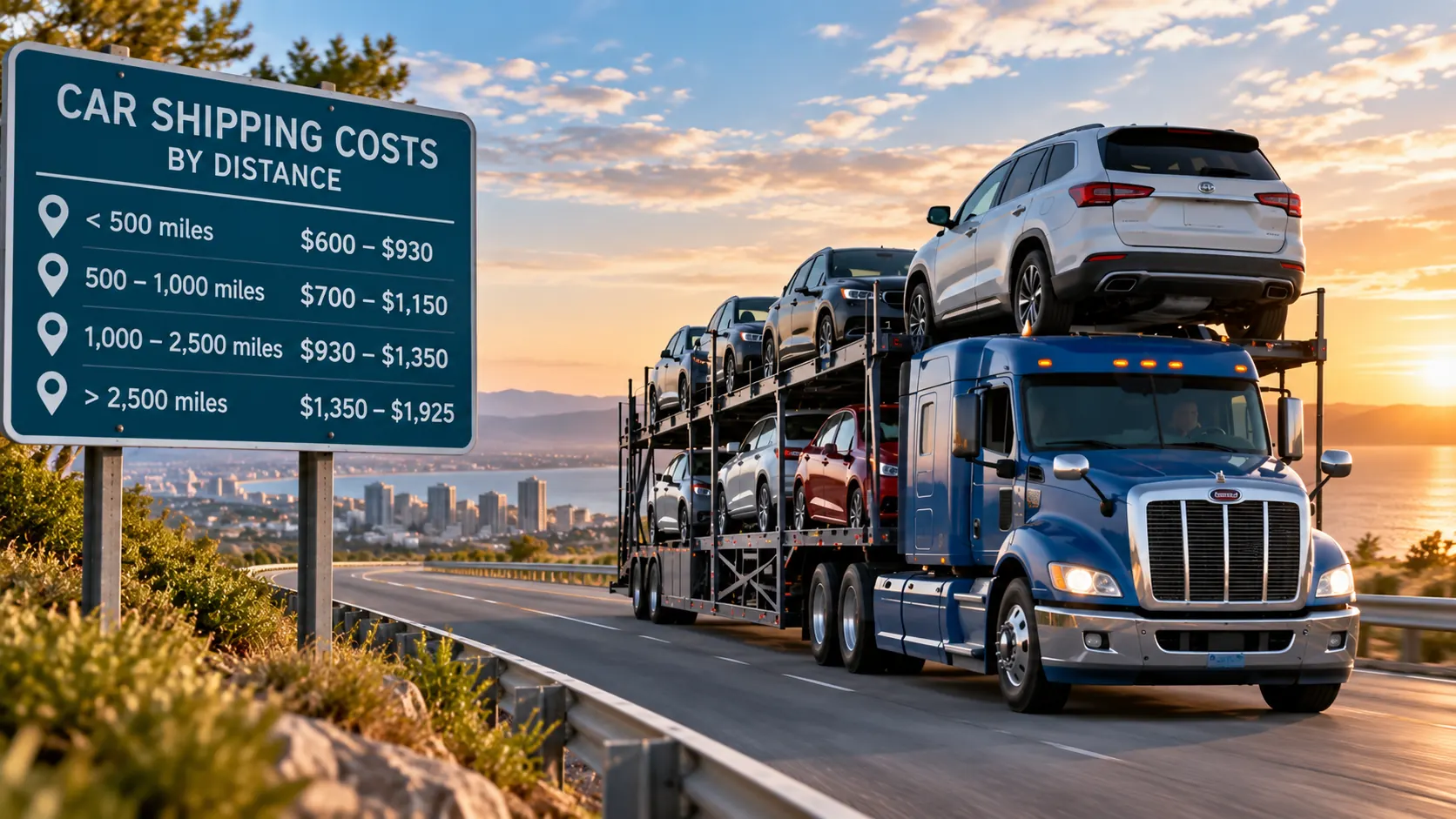
Quick Answer: Most car shipments cost between $600 and $1,925, according to ShipYourCarNow’s 2026 U.S. Car Shipping Industry Report. Short regional trips under 500 miles typically run $600 to $930, while true cross-country moves over 2,500 miles run $1,350 to $1,925. Your exact price comes down to three things: distance, vehicle size, and whether you choose open or enclosed transport. Get an instant car shipping quote to see a real number for your route in under a minute.
How much does it cost to ship a car in 2026? For most vehicles, the honest answer is somewhere between $600 and $1,925, depending on distance, though your actual auto transport costs depend on where the car is going, how big it is, and when you book. I have spent 17 years pricing vehicle shipping orders for ShipYourCarNow customers, and the first question almost every one of them asks is some version of “is this quote real, or is it about to change on me?” This guide breaks down real 2026 car shipping costs by distance, vehicle type, and shipping method, so you walk into your first quote already knowing what a fair number looks like.
What You Should Know Before You Start
Is the first quote I get the price I actually pay?
It depends entirely on who you book with. Here is what separates a real quote from a placeholder number:
- A binding quote is based on your actual vehicle, route, and timeline, not a rough guess.
- A non-binding “teaser” quote can climb once a carrier actually looks at the job.
- Ask directly whether the number you are given is locked in or subject to change at pickup.
- Get everything in writing before you pay a deposit.
What is the difference between open and enclosed transport?
Open transport moves your car on an uncovered, multi-vehicle trailer. Enclosed transport keeps it inside a covered trailer, shielded from weather and road debris.
- Open transport is what most people use. It is the more affordable, more widely available option.
- Enclosed transport typically costs 30 to 60 percent more.
- Enclosed makes the most sense for classic, luxury, or exotic vehicles.
Does the time of year change my price?
Yes. Car shipping runs on supply and demand like any other transport service.
- Late spring through summer is the busiest, and typically the most expensive, stretch of the year.
- Winter tends to bring lower demand and softer pricing, outside of snowbird routes.
- Booking with a few weeks of flexibility usually gives you access to better rates.
Can I get a lower price if my car does not run?
No. Inoperable vehicles usually cost more, not less.
- A car that cannot be driven onto the trailer needs a winch or forklift to load and unload.
- That extra equipment and labor typically adds $150 to $300 to your total.
- Always tell your broker upfront if the vehicle does not run. It affects which carriers can even take the job.
How fast do prices change once I request a quote?
Faster than most people expect.
- Most car shipping quotes are only valid for 24 to 48 hours.
- Carrier availability shifts daily based on what routes are filling up.
- If you are not ready to book yet, plan to request a fresh quote closer to your actual ship date.
Car Shipping Cost Snapshot
|
$600 to $1,925
Total cost range across all distances
|
$0.50 to $2.60
Open carrier rate per mile, by distance
|
|
|
About 90%
Of vehicles shipped on open carriers
|
30 to 60%
How much more enclosed transport costs
|
|
In This Guide
- How Much Does It Cost to Ship a Car? The 2026 Averages
- Car Shipping Costs by Distance
- Car Transport Cost by Vehicle Type and Size
- Open Carrier vs. Enclosed Transport: Which Costs More
- What Actually Moves Your Car Shipping Quote Up or Down
- Using a Car Shipping Cost Calculator to Get a Realistic Range
- Cross-Country Car Shipping: What to Expect
- Ways to Lower Your Car Shipping Cost Without Cutting Corners
How Much Does It Cost to Ship a Car? The 2026 Averages
Car shipping prices vary more than people expect, but the range holds up across most routes. According to ShipYourCarNow’s 2026 U.S. Car Shipping Industry Report, total shipping costs run from around $600 for a short regional move up to $1,925 for a true coast-to-coast haul, with a clear pattern underneath. The per-mile car shipping rate on open carriers ranges from about $1.55 to $2.60 on trips under 500 miles, down to $0.50 to $0.65 on hauls over 2,500 miles. The total goes up with distance but the rate per mile goes down.
 |
“The price we quote you is going to be the price we charge you when it comes to shipping your vehicle.” Marco Maggiore, CSO, ShipYourCarNow LinkedIn |
Good to Know: A wide price range does not mean pricing is random. Distance, vehicle size, and transport method explain almost all of the difference between a $600 quote and a $1,900 quote. For the full picture, our breakdown of why car transport costs vary so much covers the less obvious factors too. Once you know your route and vehicle, you can get an instant car shipping quote and see exactly where you land.
Averages are a starting point, not a promise. If you want the full breakdown of how car shipping costs are calculated, the sections below walk through every factor that applies to your shipment, starting with distance.
Car Shipping Costs by Distance
Distance is the single biggest driver of your total car shipping cost, but it does not scale in a straight line. Short trips cost more per mile because the carrier still has to cover the same fixed costs of dispatch, loading, and paperwork over fewer miles. Longer hauls cost more overall, but the per-mile rate drops the farther the car travels.
| Distance Band | Total Cost (Sedan) | Per-Mile Rate |
|---|---|---|
| Under 500 miles | $600 to $930 | $1.55 to $2.60 |
| 500 to 1,000 miles | $800 to $1,250 | $1.00 to $1.45 |
| 1,000 to 1,500 miles | $1,050 to $1,510 | $0.80 to $1.10 |
| 1,501 to 2,500 miles | $1,200 to $1,850 | $0.55 to $0.95 |
| Over 2,500 miles (true cross-country) | $1,350 to $1,925 | $0.50 to $0.65 |
Figures come from ShipYourCarNow’s 2026 U.S. Car Shipping Industry Report and reflect open carrier rates for a standard sedan.
Total Cost by Distance, Visualized
Bar length reflects the midpoint total cost for each distance band. The longest bar is also the most efficient on a per-mile basis.
Real-world route data backs this up. Shipments between California and Texas have recently priced between $1,201 and $1,843, while South Dakota to New York has run $1,385 to $1,979, according to route pricing published by FreightWaves Checkpoint.
💡 Pro Tip: If your pickup or delivery point is a major metro area, you will usually see a lower price than someone shipping from a rural address on the same general route. Metro corridors have frequent carrier availability, since carriers already run those routes daily, while a remote pickup or drop-off location can mean an extra trip off the main highway.
Car Transport Cost by Vehicle Type and Size
Your car transport cost is not just about miles. Vehicle size and vehicle condition change how many cars fit on a trailer and how much fuel the carrier burns, and both of those get baked into your price.
- Sedans and compact cars: The baseline for most quotes. Easiest to load and the cheapest to ship.
- SUVs and minivans: They cost more than sedans because of added height and weight.
- Pickup trucks: Full-size and dually trucks often cost more still, since they can take up more trailer space.
- Non-running vehicles: Brokers who ship non-running vehicles need $150 to $300 more for the winch or forklift required to load and unload them.
- Low-clearance vehicles: Sports cars and lowered vehicles often need an enclosed car carrier or special ramps to load safely, which can add cost.
- High-value and exotic vehicles: Often shipped enclosed regardless of size, for added protection.
| Vehicle Type | Cost Impact |
|---|---|
| Sedans and compact cars | Baseline rate |
| SUVs and minivans | Above baseline |
| Pickup trucks (full-size / dually) | Highest of standard vehicle types |
| Non-running vehicles | +$150 to $300 |
| Low-clearance vehicles | Varies, ramps or enclosed carrier often needed |
| High-value and exotic vehicles | Enclosed transport recommended |
As Marco Maggiore puts it, “Whether you’re shipping your mom’s 2001 Toyota Camry or a new Bugatti rolling off the block, we can handle both with the same level of security, service, and care.” The vehicle changes the price. It does not change the standard of care.
Every shipment moves under carrier cargo insurance, so your car is insured for the length of the trip. Federal minimums are low, but most reputable brokers require carriers to carry well above the FMCSA’s minimum filing requirements. If your vehicle is worth more than standard coverage, ask about additional insurance coverage before you book, especially for classic or exotic vehicles. Before pickup, check your tire pressure, remove toll tags, and photograph any existing damage so there is a clear record on both ends.
Vehicle Details That Affect Your Quote
✓ Year, make, and model
✓ Running condition and general vehicle condition
✓ Modifications, lift kits, or low clearance
✓ Whether it is being shipped with personal items inside
✓ Whether you want additional insurance coverage
Open Carrier vs. Enclosed Transport: Which Costs More
Open carrier transport, also called open car transport, is the industry standard. About 90% of vehicles in the United States ship this way, according to FreightWaves Checkpoint, because open car carriers carry more vehicles per trip and keep the per-vehicle cost down. Your car rides are exposed to weather and road debris, but for a daily driver, that trade-off rarely matters.
Enclosed transport keeps your car inside a fully covered trailer, protected from the elements for the entire trip. That protection comes at a real cost. Enclosed transport typically runs 30 to 60 percent more than open transport for the same route, since enclosed carriers carry fewer vehicles and give each one more space, usually two to six per load instead of seven to ten.
| Open Carrier | Enclosed Transport | |
|---|---|---|
| Relative cost | Baseline rate | 30 to 60% more |
| Vehicles per load | Seven to ten | Two to six |
| Weather protection | Exposed to weather and road debris | Fully covered, protected the entire trip |
| Best for | Daily drivers, standard moves | Classic, luxury, and exotic vehicles |
Watch Out: A quote that seems far below every other estimate you received is worth a second look. Marco Maggiore has seen this pattern play out for years: “You could always go online and find transport for less money, but what is really the cost of that $50 savings? What is the risk that you’re opening yourself up to?” A quote that is dramatically lower is not always a better deal. It can be a sign of a broker who plans to raise the price once a driver is already assigned.
Choose open car shipping for a standard daily driver where budget matters most. Choose enclosed car shipping for a classic, luxury, or exotic car where protecting the paint and body is worth the premium.
What Actually Moves Your Car Shipping Quote Up or Down
Once distance, vehicle type, and transport method are set, a handful of smaller factors round out your final car shipping quote. Understanding the vehicle transportation process helps first-time car shippers know what they are actually paying for at each step.
- Season. Summer is the busiest stretch of the year, driven by relocations, college move-ins, and vacation travel. If you are shipping for the first time, it helps to understand how the car shipping process works from booking to delivery, since that timeline shifts with demand. Prices generally ease up once demand cools in the fall and winter.
- Snowbird timing. Migration season drives real price swings on North-South corridors. ShipYourCarNow’s 2026 U.S. Car Shipping Industry Report shows the northbound “main wave” running April 6 to May 10, with prices climbing 10 to 20 percent compared to fall rates, while the southbound peak runs October 16 to November 20. Our snowbird car shipping guide covers how to time those routes for the best rate.
2026 Snowbird Migration Windows
| Jan | Feb | Mar | Apr | May | Jun | Jul | Aug | Sep | Oct | Nov | Dec |
■ Northbound “Main Wave,” April 6 to May 10 ■ Southbound Peak, October 16 to November 20
- Fuel prices. Diesel is one of the highest costs a carrier absorbs, and current gas prices at the pump are factored directly into your rate. Every empty mile a carrier drives between loads, known as deadhead, also adds cost that eventually shows up in quotes across the board.
- Pickup and delivery location. Major metro hubs are cheaper to service than remote addresses, since carriers already run those routes daily.
- Delivery method. Door-to-door delivery is standard and convenient. Terminal-to-terminal delivery, where you drop off and pick up at a depot, can lower the cost since it saves the carrier extra stops.
- Flexible pickup dates. A firm, single-day pickup window limits which carriers can take the job. A flexible window opens up more options and often a better rate.
- Urgent timelines. If your move cannot wait, expedited car shipping gets your vehicle prioritized for pickup, usually at a premium over standard scheduling. Expedited shipping works best when your dates are already firm.
- Competition among carriers. Many auto transport companies compete for the same loads, especially on busy corridors, which helps keep pricing competitive across the industry.
Carriers are not padding quotes for fun. ShipYourCarNow’s 2026 U.S. Car Shipping Industry Report puts industry-wide non-fuel operating costs at a record USD 1.779 per mile, and that squeeze on carrier margins flows straight into consumer quotes.
Good to Know: ShipYourCarNow’s carriers go through a vetting process that checks overall performance, individual driver history, current USDOT compliance, and active insurance before they are ever assigned a load. That vetting does not show up as a line item on your quote, but it is part of what you are paying for. Not every transport company applies that level of scrutiny to the shipping process, which is why comparing auto transport services matters as much as comparing price.
Using a Car Shipping Cost Calculator to Get a Realistic Range
A car shipping cost calculator is the fastest way to turn all of the factors above into an actual number. This kind of shipping cost calculator uses your pickup and delivery zip codes, your vehicle details, and your preferred timeline to return a realistic price range in seconds, not a single number pulled out of thin air.
Understanding how your car transport cost is calculated helps you spot a fair quote right away. Most tools weigh the same core inputs: distance, vehicle type, transport method, and current demand on your route.
Here is how to use a free car shipping calculator well:
- Have your exact pickup and delivery zip codes ready. General city names give a rough estimate at best.
- Enter your vehicle honestly, including whether it runs.
- Compare car shipping quotes from more than one source, side by side.
- Treat the calculator result as a starting range, then confirm the final number with a real agent before booking.
Requesting a car shipping quote through ShipYourCarNow gives you both. You get an instant vehicle shipping quote, and then a dedicated coordinator who confirms the details and locks in your actual price.
Cross-Country Car Shipping: What to Expect
Cross-country routes, generally anything over 2,500 miles, come with the highest total price tag but the lowest cost per mile of any distance band. According to ShipYourCarNow’s 2026 U.S. Car Shipping Industry Report, a coast-to-coast open transport shipment typically runs $1,350 to $1,925, at roughly $0.50 to $0.65 per mile, the most efficient per-mile rate in the entire distance table. Enclosed transport on the same route runs higher, generally in line with the 30 to 60 percent premium that holds across shorter distances too.
A few things set cross-country moves apart from shorter routes:
- Transit time is longer, often 5 to 10 days depending on the route and weather.
- Fuel costs make up a larger share of the total price, since the carrier is covering thousands of miles.
- Seasonal demand swings hit cross-country pricing harder than short regional routes, since these carriers serve the entire national market.
💡 Pro Tip: If you are relocating across the country for work, military orders, or school, book your car shipping as soon as your dates are confirmed. Cross-country carriers fill their schedules further in advance than regional ones, and last-minute cross-country bookings tend to see the steepest price jumps.
Ways to Lower Your Car Shipping Cost Without Cutting Corners
You do not have to choose between a fair price and a safe shipment. A few practical moves can bring your car shipping cost down without adding risk.
- Be flexible on pickup dates. Even a 3- to 5-day window instead of one fixed date can open up better carrier options.
- Choose terminal-to-terminal if it works for your schedule. It shifts some of the legwork to you, but it can lower your total cost.
- Ship in the off-season when you can. If your timeline allows it, avoiding the summer peak generally means a better rate.
- Compare real, written quotes. Get more than one quote for the same route and vehicle so you are comparing apples to apples, not a placeholder number against a real one.
- Ask what is actually included. A slightly higher quote that includes full insurance and a dedicated coordinator can end up cheaper than a rock-bottom number with hidden gaps.
- Compare more than one car shipping company. Rates for auto shipping can shift between car transport companies on the exact same route, so a second or third quote often pays off.
For a deeper look at more ways to reduce your car shipping costs, including tips based on your vehicle type, see our full savings guide.
|
“We treat every car that we ship as if it was our own personal vehicle. We want you to be comfortable, we want you to be educated, and we’re here to provide that for you.” Marco Maggiore, CSO, ShipYourCarNow LinkedIn |
Why ShipYourCarNow
Pricing transparency is not a marketing line for us. It is the whole model. As a car shipping company, ShipYourCarNow has spent more than 17 years building auto transport services around one idea: the price you are quoted is the price you pay, backed by our Fixed Price Promise.
This applies whether you are a first-time shipper looking for straightforward car shipping services, a snowbird, or a family handling a military vehicle shipping move on a fixed government timeline.
Here is what that looks like in practice:
- FMCSA-licensed and BBB-accredited, with thousands of verified customer reviews across Google, BBB, Consumer Affairs, and BirdEye.
- Every carrier goes through a stringent vetting process covering overall performance, individual driver history, current USDOT compliance, and active insurance.
- Every carrier we assign carries a minimum of $1,000,000 in liability insurance and $100,000 in cargo insurance.
- Claims stay in-house. We don’t outsource our claims. We have our own claims team that works to resolve issues quickly and without added stress to the customer.
- A dedicated shipping coordinator is assigned to your order from booking through delivery.
- 24/7 customer support, every day of the year, because as Marco puts it, “cars don’t stop, this industry doesn’t stop.”
- Our Know Your Trucker program sends you a text before pickup with your assigned driver’s photo, license information, and equipment confirmation.
- Locked-in pricing with no hidden fees. The price quoted is the price charged.
From Quote to Delivery
If you are ready to see a real number for your route, get an instant car shipping quote or call us at (866) 390-0354.
Stop guessing at averages and get a car transport quote built for your actual vehicle, route, and timeline. Every auto transport quote from ShipYourCarNow is backed by our Fixed Price Promise.
Frequently Asked Questions
How much does it cost to ship a car on average in 2026?
Total cost runs from about $600 for a short regional move up to $1,925 for a true cross-country haul, according to ShipYourCarNow’s 2026 U.S. Car Shipping Industry Report, with your exact price depending on distance, vehicle size, and transport method. Short regional trips typically run $600 to $930, while long cross-country moves typically run $1,350 to $1,925. The best way to get a number that matches your situation is to request a free quote with your real pickup and delivery details.
Is it cheaper to ship a car open or enclosed?
Open transport is almost always cheaper. It typically costs 30 to 60 percent less than enclosed transport, since open trailers carry more vehicles per trip and spread the cost across more customers. Enclosed transport still makes sense for classic, luxury, or high-value vehicles where the extra protection is worth the premium.
How much does it cost to ship a car 1,000 miles?
A 1,000-mile shipment sits right at the boundary between our short- and mid-range distance bands, typically running $1,050 to $1,250 on an open carrier, according to ShipYourCarNow’s 2026 U.S. Car Shipping Industry Report. Your actual price will move up or down based on your exact route, vehicle size, and how far in advance you book.
Does the cost change if my car does not run?
Yes, and it goes up, not down. A non-running vehicle needs a winch or forklift to load and unload safely, and that extra equipment and labor typically adds $150 to $300 to your total. Always tell your broker upfront if your vehicle is inoperable so they can assign a carrier equipped to handle it.
What is the cheapest way to ship a car?
Open transport is the most affordable shipping method for most vehicles, and choosing terminal-to-terminal delivery instead of door-to-door can lower the price further. Booking with flexible pickup dates and shipping during the off-season also helps keep your costs down without sacrificing safety or service.
What is the cheapest time of year to ship a car?
Late fall and winter tend to bring the lowest demand and typically the most competitive pricing, outside of snowbird routes heading south. Summer is the busiest and generally the most expensive season, since it overlaps with relocations, college move-ins, and vacation travel. If your schedule allows flexibility, shipping outside the summer peak is one of the simplest ways to save.
Does an SUV or pickup truck cost more to ship than a sedan?
SUVs, minivans, and pickup trucks typically cost more than sedans because they take up more trailer space and add weight, which increases fuel use. Sedans and compact cars serve as the baseline for most quotes, with larger vehicles priced up from there based on their exact size and weight.
Is door-to-door or terminal-to-terminal cheaper?
Terminal-to-terminal delivery is usually the cheaper option, since it saves the carrier from making an extra stop off their main route. Door-to-door auto transport costs a bit more, but it is the more convenient choice for most customers and is standard for the majority of shipments.
What is the cheapest company to ship a car?
There is no single auto transport company that is cheapest across every route, vehicle, and season. Rates among auto transport companies shift constantly based on demand, so any transport company that names a fixed lowest price without knowing your details is worth a second look. The smarter approach is comparing written quotes from a few FMCSA-licensed, insured car transport companies for your exact route, then weighing price against carrier vetting, insurance coverage, and claims support.
What is the cheapest way to ship a car internationally?
International shipping costs are driven largely by port fees, customs, and whether the vehicle ships in a shared or dedicated container, so pricing looks very different from domestic routes. Booking early, using a shared container where your route allows it, and confirming all documentation upfront are the most reliable ways to avoid paying more than necessary when you ship a car overseas.
Whatever your route looks like, understanding how much it costs to ship a car before you request a quote puts you in a much stronger position to spot a fair price when you see one.






Senior automotive logistics professional with a passion for the industry and a 10+ year history of accomplishments. Proven track record of exemplary client management working with both RMCs, Van Lines and OEMs. Keen ability to react to an ever-changing marketplace while offering superior technology solutions, programs and services. Architect of award winning auto transport portal technology offering transparency and agility to clients, agents and transferees. Successful team builder and leader easily managing budgets with effective leadership, strategic planning, and problem-solving capabilities.