
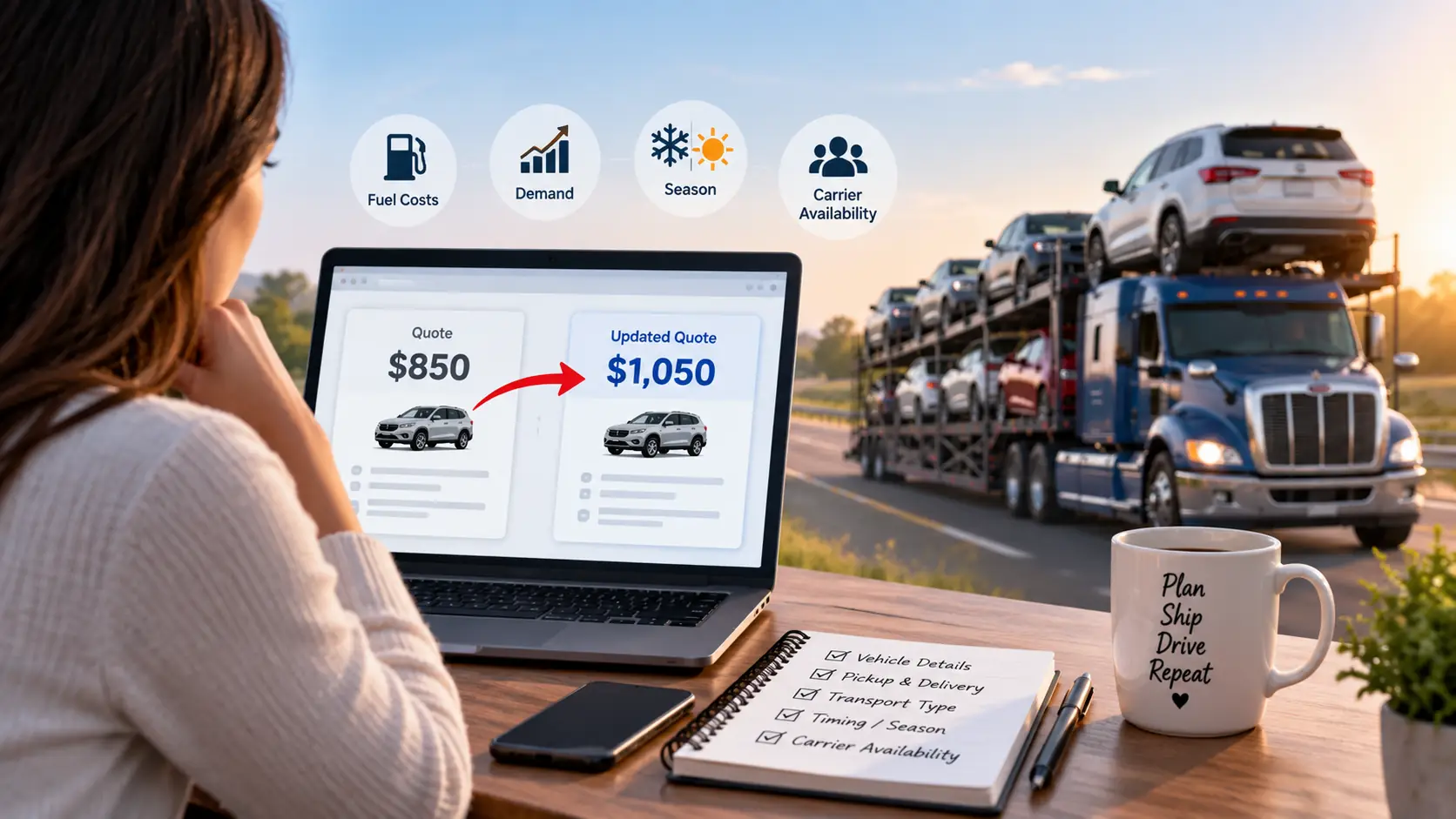

Quick Answer: A car shipping quote changes because auto transport pricing follows a live market, not a fixed rate card. Fuel costs, carrier availability, the season, and your exact vehicle details all move the price between your first estimate and the day a carrier actually accepts the load. The way to get a car shipping quote that holds is to work with a company that locks in your price once it’s confirmed and puts everything in writing.
A car shipping quote can look completely different by the time your vehicle gets picked up, and that catches a lot of first-time shippers off guard. If you booked a quote a few weeks ago and now a company is asking for more money, you’re not imagining it. This guide breaks down why that happens and what you can do to get a quote that actually holds.
What You Should Know Before You Start
What information do I need before requesting a car shipping quote?
- Your vehicle’s year, make, and model
- Whether the vehicle can be driven or needs to be towed onto the carrier
- Exact pickup and delivery ZIP codes
- Your ideal pickup window, plus how flexible you can be
- Whether you want open or enclosed transport
Is my first quote the final price?
- Not always. A quote is only as accurate as the details behind it.
- Instant online estimates are a starting point, not a locked rate, unless the company guarantees the price in writing.
- A written quote should spell out exactly what’s included and what could add cost later.
How long does car shipping actually take?
- Most coast-to-coast moves take 7 to 10 days from pickup to delivery.
- Shorter regional moves can be completed in 1 to 2 days.
- Delivery windows are estimates. Weather, traffic, and route conditions can shift them.
Should I choose open or enclosed transport?
- Open transport works for the vast majority of everyday vehicles and costs less.
- Enclosed transport protects the vehicle from road debris and weather, and makes sense for classic, luxury, or exotic cars.
- Your choice here changes the quote more than almost any other factor.
By the Numbers
|
$700 to $1,150
Typical car shipping cost in 2026
|
$0.61 to $2.60
Cost per mile for auto transport
|
7 to 10 days
Typical coast-to-coast delivery window
|
1 to 5 days
Standard carrier pickup window
|
Cost and per-mile figures are based on FreightWaves 2026 car shipping cost data.
In This Guide
- What Determines Your First Car Shipping Quote
- Why Car Shipping Quotes Change After You Book
- How Vehicle Type, Size, and Condition Change Your Quote
- Open Transport vs Enclosed Transport and the Price Difference
- Timing, Seasonal Demand, and Carrier Availability
- How Insurance Coverage Affects Your Vehicle Shipping Quote
- How to Get a Car Shipping Quote That Actually Holds
What Determines Your First Car Shipping Quote
Getting a reliable car shipping quote starts with understanding how the auto transport market actually works. Brokers and carriers price a shipment based on real-time supply and demand, not a printed rate sheet, so the same route can have different costs depending on the day you ask.
Your first quote gets built from a handful of details:
- Pickup and delivery locations, including how far apart they are
- Vehicle size, weight, and whether it drives
- Transport type, such as open or enclosed
- How flexible your pickup date is
Providing accurate vehicle details up front matters more than most people realize. If the year, make, model, or running condition is different once a carrier actually looks at the car, the price can change too. This is one of the most common reasons a quote changes between booking and pickup, and it’s avoidable simply by double-checking the details before you submit them.
Many auto transport companies offer a car shipping calculator so you can get a rough car shipping estimate before you commit to anything. ShipYourCarNow’s car shipping cost calculator shows how car transport cost gets calculated, using your vehicle details, pickup and delivery dates, and transport type to build a starting number.
From Quote to Delivery
Pickup and delivery method matters too. Most customers choose door-to-door auto transport, where a carrier picks up and drops off as close to your exact addresses as road access allows, rather than meeting at a shipping terminal. This door-to-door transport option is the most common choice in the vehicle transportation process today.
You can see exactly how car shipping costs are calculated and what goes into a fair and accurate estimate.

“You could always go online and find transport for less money, but what is really the cost of that $50 savings? What is the risk that you’re opening yourself up to?”
Marco Maggiore, CSO, ShipYourCarNow
Why Car Shipping Quotes Change After You Book
Car shipping quotes can change after booking for a few clear reasons, and almost all of them come down to market conditions shifting between your request and the day a carrier picks up your car.
The biggest drivers include:
- Fuel prices. Diesel is a major operating cost for carriers, and a jump in fuel prices can raise what a driver needs to accept a load.
- Carrier availability. If fewer trucks are running your route on your dates, the price a carrier will accept goes up.
- Route popularity. High-demand corridors move faster and cheaper. Less common routes can cost more simply because fewer carriers cover them.
- Timing and seasonality. The time of year plays a real role in what carriers charge, which we cover in detail below.
Auto transport costs and car shipping rates move with the broader vehicle transport market, not just your route. When fuel or carrier costs rise across the industry, car shipping prices tend to follow for everyone, which is why the same car transport cost can look different from one month to the next.
A quote that comes in well below the market average is often a red flag rather than a deal. If no carrier will actually accept that price, the shipment sits unassigned, or the broker comes back later asking for more money once a driver is finally found. A car transport service that quotes low just to win the booking rarely holds that number once a carrier is actually needed. For a deeper breakdown of this exact issue, our team put together a full look at why car transport costs vary so much.
Watch Out: If one quote comes in far below every other quote you’ve received, ask why before you book. A price that no carrier can actually work with tends to change later, or it sits without a driver assigned.
How Vehicle Type, Size, and Condition Change Your Quote
Not every car costs the same to ship, and this is one of the clearest reasons a car transport quote can shift once a company confirms your vehicle’s actual specifications.
Larger vehicles take up more space on a carrier and add weight, which raises the price. Inoperable vehicles need extra equipment and labor to load, which typically adds $150 to $350 to the total cost. High-value vehicles, whether a classic, exotic, or luxury model, often move to enclosed transport for added protection, which changes the quote on its own.
Vehicle condition affects both the cost and process. A car with a dead battery, low tire pressure, or mechanical issues can slow down loading and unloading, and a carrier may adjust pricing once they know the full picture. Experienced car shippers know to flag these details early, since an accurate vehicle shipment description from day one is what keeps the quote from changing later.
“Whether you’re shipping your mom’s 2001 Toyota Camry or a new Bugatti rolling off the block, we can handle both with the same level of security, service, and care.”
Marco Maggiore, CSO, ShipYourCarNow
Before Pickup Checklist:
- ✓ Clean the vehicle inside and out
- ✓ Check tire pressure and fluid levels
- ✓ Keep the fuel tank at about a quarter full
- ✓ Remove personal items and valuables
- ✓ Take photos of the vehicle’s condition from all angles
Open Transport vs Enclosed Transport and the Price Difference

Transport type, open versus enclosed, is one of the biggest levers on any car shipping quote. Open transport is the standard choice for most vehicles and moves cars on the same style of carrier you’ll see hauling new inventory to dealerships. Enclosed transport shields the vehicle from weather and road debris inside a covered trailer, and it typically runs about 30 to 60 percent more than open transport, according to FreightWaves pricing data.
Most everyday sedans, trucks, and SUVs ship just fine on open transport. Enclosed auto transport makes more sense for:
- Classic and antique vehicles
- Exotic or luxury cars
- Vehicles with low ground clearance
- Any car where the owner wants extra peace of mind
| Feature | Open Transport | Enclosed Transport |
| Best for | Everyday sedans, trucks, and SUVs | Classic, exotic, and luxury vehicles |
| Typical cost | Industry standard, lower cost | 30 to 60 percent more than open |
| Weather protection | Exposed to weather and road debris | Fully covered and protected |
| Carrier availability | Widely available | Fewer carriers, longer lead time |
You can compare the details of open car shipping and enclosed car shipping to figure out which fits your vehicle and your budget. Weighing open and enclosed transport side by side before you book is the easiest way to know exactly what you’re paying for.
Timing, Seasonal Demand, and Carrier Availability
Timing changes a car shipping quote more than most people expect. Carriers typically require a pickup window of 1 to 5 days rather than an exact date, since routes, weather, and prior deliveries all affect a truck’s schedule. Flexible shipping dates are one of the simplest ways to save money on a shipment, since carriers can slot a flexible vehicle into a route that’s already running.
Seasonal demand plays a role too. Summer months bring a wave of relocations, and snowbird season each fall and spring sends a large number of vehicles up and down the same coastal corridors at once. When demand rises on a route, the price to move a car on that route tends to rise with it. The same goes for online vehicle purchases and auction wins, where the seller often needs a firm pickup date before the sale is considered final.
If you’re moving seasonally between two homes, our guide to snowbird car shipping covers how to time a shipment around the busiest windows. If your timeline is tight, expedited car shipping is built for exactly that situation. Expedited shipping usually comes at a premium, since it asks a carrier to prioritize your vehicle ahead of other loads.
💡 Pro Tip: Booking at least two weeks ahead of a hard deadline gives carriers more room to plan your pickup, which usually works in your favor on price. The more flexible your dates, the more options a carrier has to fit your car into an existing route.
How Insurance Coverage Affects Your Vehicle Shipping Quote
Every legally operating carrier is required to carry liability insurance, and a carrier’s cargo insurance is already built into your car shipping quote. What changes the price is the level of coverage tied to your vehicle.
A few things worth knowing:
- Standard cargo insurance covers most everyday vehicles at no extra cost.
- High-value vehicles may need enhanced coverage, which can add to the quote.
- Documenting your vehicle’s condition with photos before pickup makes any insurance claim easier to resolve.
- Most carriers do not cover personal items left inside the vehicle, so it’s best to remove them before pickup.
Reviewing insurance coverage terms before you book, not after, is one of the simplest ways to avoid a surprise later in the process.
How to Get a Car Shipping Quote That Actually Holds
This is the part that actually matters once you understand why quotes change. A car shipping quote that holds comes down to finding the right auto transport provider, one that prices it right the first time and stands behind that number. Not every auto transport provider treats a locked-in price the same way once a carrier is actually assigned.
A few habits make a real difference:
- Compare at least three quotes. This gives you a real sense of the market rate for your route and makes a lowball or inflated number easy to spot. Our quote comparison guide walks through what to look for when you compare auto transport quotes from multiple car transport companies.
- Get it in writing. A written quote should detail everything included and anything that could add cost later, so there are no surprises on pickup day.
- Understand the Bill of Lading. This document records your vehicle’s condition at pickup and delivery, and it’s worth reading closely before you sign anything.
- Ask about the car transport process. A company that walks you through each step, from pickup to delivery, is less likely to spring a surprise fee mid-route.
- Ask how the price is locked. Some companies lock a quote once it’s confirmed. Others treat it as a rough starting point that shifts once a carrier gets involved.
Competitive pricing paired with a dedicated coordinator and an in-house claims team tends to hold up better over time than the cheapest number on the page.
“The price we quote you is going to be the price we charge you when it comes to shipping your vehicle.”
Marco Maggiore, CSO, ShipYourCarNow
Good to Know: There’s nothing wrong with a company asking for a deposit. The issue is a company that stops communicating once that deposit clears. A written quote and a team that stays with you through delivery are the two best signs your price is going to hold.
If you want to see how this plays out for real customers, our verified customer reviews show what the car shipping process looks like from booking through delivery. You can also read a full walkthrough of how the car shipping process works from start to finish, across all of our car shipping services.
Why ShipYourCarNow
I’ve spent 17 years in the auto transport industry, and the single biggest source of frustration I hear from customers is a quote that didn’t hold. That’s the exact problem our Fixed Price Promise was built to solve. The price you’re quoted is the price you pay, with no surprise charges once your carrier is assigned.
Whether you call us a car shipping company or an auto transport company, the job is the same. We ship your car exactly the way we quoted it, with door-to-door delivery and handled with care until your vehicle arrives.
Here’s what backs that promise up, across every one of our auto transport services:
- FMCSA-licensed and BBB-accredited (MC# 714617)
- Every carrier is vetted for overall performance, individual driver performance, USDOT compliance, and insurance verification
- All carriers hold a minimum of $1,000,000 in liability insurance and $100,000 in cargo insurance
- An in-house claims team, never outsourced to a third party
- A dedicated shipping coordinator is assigned to your order from booking to delivery
- 24/7 customer support, every day of the year
- Our Know Your Trucker program, which sends you your driver’s photo, license information, and equipment confirmation before pickup
- Thousands of verified customer reviews across Google, BBB, Consumer Affairs, and BirdEye
“We don’t outsource our claims. We have our own claims team in-house that works to resolve those issues quickly and without any additional stress or friction to our customer.”
Marco Maggiore, CSO, ShipYourCarNow
This matters just as much for a family relocating across the country as it does for a service member managing a military move and vehicle shipping on a fixed timeline. Whatever’s bringing you here, our team is ready to help.
Have more questions first? Our full FAQ page covers the rest of the process in detail, and our tips for reducing car shipping costs can help you plan a shipment that fits your budget.
Call us at (866) 390-0354, or get an instant car shipping quote right now.
Ready for a car shipping quote that actually holds?
Get a fixed, written price in minutes. No surprise charges once your carrier is assigned.
Frequently Asked Questions
Why do car shipping quotes change after I book?
Quotes usually change because market conditions shift between the day you request a price and the day a carrier actually picks up your vehicle. Fuel costs, carrier availability, and route demand can all move between booking and pickup. Inaccurate vehicle details, like running condition or size, can also cause a quote to be adjusted once a carrier reviews the shipment. Working with a company that locks your price once it’s confirmed removes most of this uncertainty.
What is the average cost to ship a car in 2026?
The average car shipping cost in 2026 falls between $700 and $1,150, though the exact price depends on distance, vehicle type, and transport method. Cost per mile typically runs from $0.61 to $2.60, with shorter routes costing more per mile than long ones. A 300-mile shipment often falls in the $250 to $400 range on open transport. This average car shipping range is a helpful starting point, but getting a personalized car transport quote is the only way to know your exact price.
Is open transport or enclosed transport better for my vehicle?
Open transport works well for the vast majority of everyday sedans, trucks, and SUVs, and it costs less than enclosed transport. Enclosed transport protects a vehicle from weather and road debris and typically costs 30 to 60 percent more. Classic cars, exotic vehicles, and luxury models are the most common candidates for enclosed transport. Your daily driver rarely needs it.
How far in advance should I book my car shipping quote?
Booking at least two weeks ahead of a hard deadline gives carriers room to plan your pickup and generally works in your favor on price. Carriers typically need a pickup window of 1 to 5 days rather than one exact date. The more flexible you can be with dates, the easier it is for a carrier to fit your vehicle into an existing route. Last-minute bookings often come with a higher price simply because fewer trucks are available on short notice.
Why did my car shipping quote go up after a carrier was assigned?
This usually happens when the original quote didn’t account for something particular to your shipment, like an inoperable vehicle, extra distance to a rural pickup address, or a change in fuel prices since the quote was issued. It can also happen with companies that quote low to win the booking, then raise the price once a carrier is actually needed. Asking how a company handles price changes before you book is the best way to avoid this.
What should a written car shipping quote include?
A proper written quote should list the base transport cost, any additional fees, the type of transport, and your estimated pickup and delivery window. It should also spell out what could change the price, such as an inoperable vehicle or a hard-to-reach pickup location. If a quote leaves any of this vague, ask for clarification before booking. This is also where understanding the Bill of Lading matters, since it documents your vehicle’s condition at pickup and delivery.
Does vehicle condition affect my car shipping quote?
Yes. A vehicle that doesn’t run needs special loading equipment, which typically adds $150 to $350 to the cost. Low tire pressure, fluid leaks, or other mechanical issues can also affect loading time and pricing. Documenting your vehicle’s condition with photos before pickup protects you either way. It’s one of the simplest steps that pays off if a question ever comes up later.
How many car shipping quotes should I compare before booking?
Comparing at least three quotes gives you a realistic sense of the market rate for your route. It also makes it easier to spot a quote that’s unrealistically low or one that’s padded with extra fees. Look past the total number and compare what’s actually included, like insurance coverage and transport type. The company with the clearest, most complete written quote is usually the safer choice.
Do I need to pay a deposit to lock in a car shipping quote?
Many companies require a deposit once a carrier is assigned, and that’s a normal part of the process. What matters is what happens after the deposit clears. A reliable company stays in communication and stands behind the original price through delivery, rather than going quiet until pickup day.
What happens if my car isn’t ready on the scheduled pickup date?
Most carriers work within a pickup window rather than on a fixed day, so some flexibility is already built in. If your vehicle truly won’t be ready, contact your shipping coordinator as soon as possible to adjust the schedule. Waiting until the last minute can affect carrier availability and, in some cases, your price. Clear communication early on keeps your car shipping quote on track.






Senior automotive logistics professional with a passion for the industry and a 10+ year history of accomplishments. Proven track record of exemplary client management working with both RMCs, Van Lines and OEMs. Keen ability to react to an ever-changing marketplace while offering superior technology solutions, programs and services. Architect of award winning auto transport portal technology offering transparency and agility to clients, agents and transferees. Successful team builder and leader easily managing budgets with effective leadership, strategic planning, and problem-solving capabilities.