
A car shipping broker coordinates your car shipping service through a network of vetted, insured carriers, comparing routes, equipment, and pricing so your car gets picked up on time. A carrier is the company that owns the truck and physically drives your vehicle. Most people shopping for auto shipping do better working with a broker, especially for interstate moves, tight timelines, or vehicles that need enclosed transport.
Ask ten people how to ship a car, and you’ll get ten different opinions on whether to use a car shipping broker or a carrier, usually built on one bad experience they heard about secondhand. After more than 17 years of vetting carriers in this industry, I can tell you the real difference is simpler than the horror stories suggest. A carrier owns the truck and physically moves the vehicle from point A to point B. A broker manages the entire car transport for you, from finding a qualified carrier to staying on the phone with you until your car arrives.
What You Should Know Before You Choose a Car Shipping Broker
What does a car shipping broker actually do?
- Compares pricing and delivery options across a network of carriers instead of just one
- Matches your vehicle, route, and timeline to a carrier who already runs that lane
- Verifies carrier insurance, USDOT compliance, and safety history before assigning your shipment
- Stays involved as your point of contact from booking through delivery
What does a carrier do?
- Owns and operates the truck that transports your vehicle
- Employs the driver who loads, hauls, and delivers your car
- Provides pickup and delivery inspections at each end of the route
- Typically runs a fixed set of regional or long-distance lanes
Is a broker more expensive than booking a carrier directly?
- Pricing depends more on route demand, vehicle size, and timing than on the booking method
- A broker’s network access can offset any added coordination cost, especially on longer routes
- A direct carrier’s price can look lower upfront, but only if that carrier already services your exact route and dates
- The best auto transport companies, brokers, or carriers are upfront about the total cost before you book
Can I book directly with a carrier instead of using a broker?
- Yes, if a carrier already runs your exact pickup and delivery route
- You take on the vetting, insurance verification, and communication that a broker would normally handle
- Direct booking tends to work best for short, regional moves with flexible timing, and it’s how many local car moving companies operate
|
$750,000
FMCSA minimum public liability insurance for interstate motor carriers
|
10 to 15%
Typical enclosed transport premium over open transport on most routes
|
$0.61 to $2.60
Typical per-mile cost for auto transport, depending on distance and transport type
|
No. 1
ShipYourCarNow’s rank in the 2026 major auto transport brokerage performance report
|
Table of Contents
- What Is a Car Shipping Broker and What Do They Do?
- What Is a Carrier and How Is It Different From a Broker?
- Car Shipping Broker vs Carrier: The Core Differences
- How Booking Method Affects Your Car Shipping Costs
- Carrier Availability and Scheduling for Your Pickup Date
- Insurance Coverage During Vehicle Transport and Shipment
- Open Transport, Enclosed Transport, and Delivery Choices
- How to Choose Between a Car Shipping Broker and a Carrier
What Is a Car Shipping Broker and What Do They Do?
A car shipping broker arranges transport through an extensive network of carriers rather than owning trucks directly, matching your auto shipping needs to the right fit. When you request a car shipping quote, the broker reviews your pickup and delivery locations, vehicle details, and shipping dates, then matches your shipment to a carrier already running that route.
- Brokers help customers compare pricing and delivery options across multiple carriers instead of just one
- A broker vets each carrier’s insurance, USDOT standing, and driver performance before assigning a shipment
- Brokers are typically preferred for unusual routes, tight schedules, or vehicles needing enclosed transport
- If you bought a vehicle online without seeing it in person, a broker can coordinate pickup from the dealer or private seller on your behalf
- One point of contact manages your car transport services from quote to delivery, instead of you tracking down a driver directly
What Is a Carrier and How Is It Different From a Broker?
A carrier owns the transport trucks and delivers vehicles along the routes it runs, whether it’s hauling sedans, SUVs, or pickup trucks. Carriers employ the drivers and operate the equipment, which is why direct communication with the person moving your vehicle directly to your destination is a real benefit of booking a carrier yourself.
Most carriers are small operations. There are roughly 2.09 million motor carriers registered with the FMCSA, and 97% run fleets of fewer than 20 trucks, with more than half operating just one truck. That fragmentation is exactly why a single carrier’s routes and open dates can be so limited.
- Carriers are responsible for the actual transport of vehicles from start to finish, functioning as the car transporter for that leg of the move
- Carriers have limited routes and may not accommodate a particular pickup date outside their regular lanes
- A carrier’s own insurance policy covers your vehicle while it rides on that carrier’s truck
- Carrier availability can shrink fast during peak moving seasons, since one carrier only has so many trailer slots
Car Shipping Broker vs Carrier: The Core Differences
How Your Shipment Moves: Broker vs. Carrier
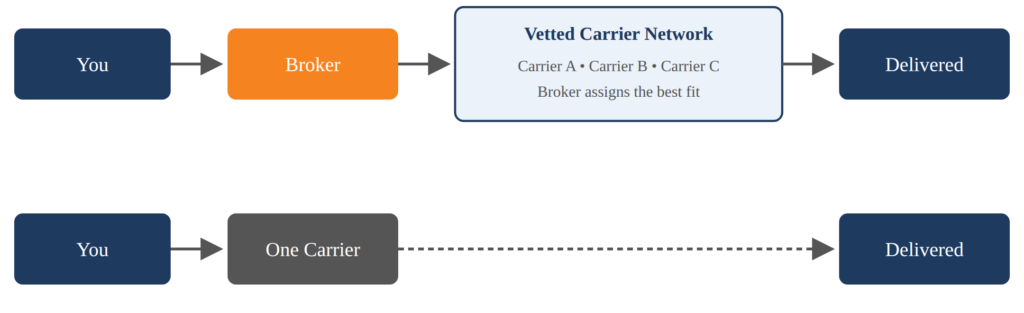
A broker matches your shipment to whichever carrier in its network fits best. A direct carrier only offers its own truck and schedule.
Neither option is universally better. A carrier that already runs your exact route on your exact date is hard to beat. A broker earns its place when your shipment doesn’t fit neatly into one carrier’s existing schedule, which describes most cross-country and time-sensitive moves.
| Category | Car Shipping Broker | Carrier |
|---|---|---|
| Owns the truck | No, coordinates a carrier network | Yes |
| Carrier options | Multiple carriers to choose from | One carrier only |
| Route flexibility | Matches shipment to available lanes nationwide | Limited to that carrier’s existing routes |
| Insurance verification | Vets each carrier before assignment | Provides its own policy |
| Communication | Single point of contact throughout | Direct line to the driver |
| Best for | Multi-state moves, tight timelines, specialty vehicles | Short regional routes with flexible timing |
Both brokers and independent car transport companies operate under the same FMCSA rules, but how closely they vet each shipment can vary a lot.
Not every broker vets carriers the same way, though.
“We refer to this as the post-and-hope mentality.” Most auto transport companies find carriers by posting a load on a general nationwide board and hoping a qualified carrier picks it up, with little to no vetting behind that match.
“In order to move a car for ShipYourCarNow, carriers have to go through a very stringent vetting process, which includes not only their overall performance but also their individual driver’s performance, making sure they’re up to date with USDOT and that their insurance is in line.”

Marco Maggiore, CSO, ShipYourCarNow | LinkedIn
How Booking Method Affects Your Car Shipping Costs
Shipping costs generally range from about $0.61 to $2.60 per mile, and longer distances lower the per-mile rate even though the total cost goes up. Vehicle size and weight play a real role in the final price, and pickup or delivery in a remote location typically costs more than a move between major metropolitan hubs. Fuel prices and seasonal demand shift these numbers too, which is why a car shipping calculator only gets you a starting estimate, not a locked-in number.
Sedan auto transport costs typically fall into these ranges by distance:
| Distance | Typical Total Cost (Sedan) |
|---|---|
| Under 500 miles | $600 to $930 |
| 500 to 1,000 miles | $800 to $1,250 |
| 1,000 to 1,500 miles | $1,050 to $1,510 |
| 1,501 to 2,500 miles | $1,200 to $1,850 |
| Over 2,500 miles | $1,350 to $1,925 |
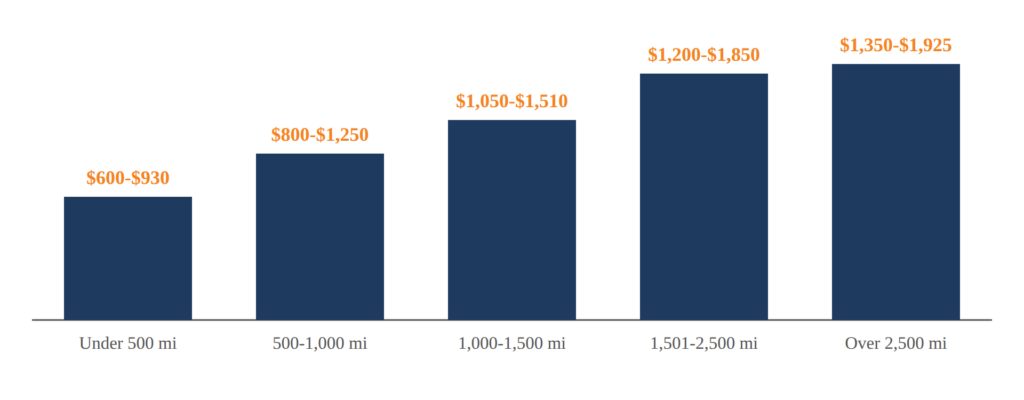
Typical total shipping cost for a sedan, by distance bracket.
- A pickup truck averages roughly $279 more to ship than a sedan, and larger vehicles generally cost more than compact cars across the board
- Inoperable vehicles typically add $150 to $350 to the shipping cost, since most carriers charge standard rates only for vehicles that can be driven on and off the trailer
- Enclosed transport typically runs 10 to 15 percent more than open transport, with the gap narrowing on the longest routes
- A broker can compare multiple carrier rates for your route before you commit to one
- A direct carrier gives you one quote, which can be accurate if that carrier already knows your route well
- Ask any provider for a written quote, an estimated delivery window, and confirmation of what the Bill of Lading covers before you sign. Most car shipping quotes are only valid for 24 to 48 hours, so lock in your rate once you’re ready to book
Good to Know: Your final invoice should match your quote. If a number changes after pickup, ask exactly what changed and why before you agree to anything. Choosing terminal-to-terminal pickup or delivery instead of door-to-door can also lower the total cost if you’re flexible on convenience.
Carrier Availability and Scheduling for Your Pickup Date
Carriers have limited routes and may not accommodate certain dates easily, especially if your pickup or delivery city sits outside their regular lanes. A broker works differently, matching your shipment to carrier availability across a much wider network, which is one reason brokers are typically preferred for tight schedules or less common routes.
Timing affects both availability and price. The busiest stretch of the year is what the 2026 industry data calls the northbound migration window, roughly April 6 through May 10, when snowbirds and seasonal movers head north, and prices can run 10 to 20 percent above fall rates. A second demand spike hits the fall southbound window, roughly October 16 through November 20, as the same seasonal shippers head south again. Summer relocations and August college move-ins add their own steady demand on top of that. January through March tends to be the slowest and most affordable stretch, though winter weather can still bottleneck certain routes and push rates up temporarily, even during an otherwise slower month.
When Car Shipping Demand Peaks
The two snowbird migration windows drive most of the year’s pricing swings.

- Peak seasons, like spring and early summer relocations, shrink carrier availability fast
- Expedited shipping options exist through brokers who can prioritize your shipment across multiple carriers
- Access to multiple car shipping companies in a broker’s network means a backup plan if your first carrier falls through
- A single carrier has no backup plan if a truck breaks down or a driver calls in sick
- Tell your broker your preferred pickup date upfront so the shipping service can prioritize carriers who can hit it
💡 Pro Tip: If your pickup or delivery date isn’t flexible, say so upfront. A broker can prioritize carriers who can hit that exact window.
Insurance Coverage During Vehicle Transport and Shipment
Vehicles are covered by the carrier’s cargo insurance policy during transit, and the FMCSA requires a minimum of $750,000 in public liability insurance for interstate motor carriers. Every carrier in the ShipYourCarNow network is required to carry a minimum of $1,000,000 in liability insurance and $100,000 in cargo insurance, well above that federal floor.
Liability Insurance: Federal Minimum vs. ShipYourCarNow Standard
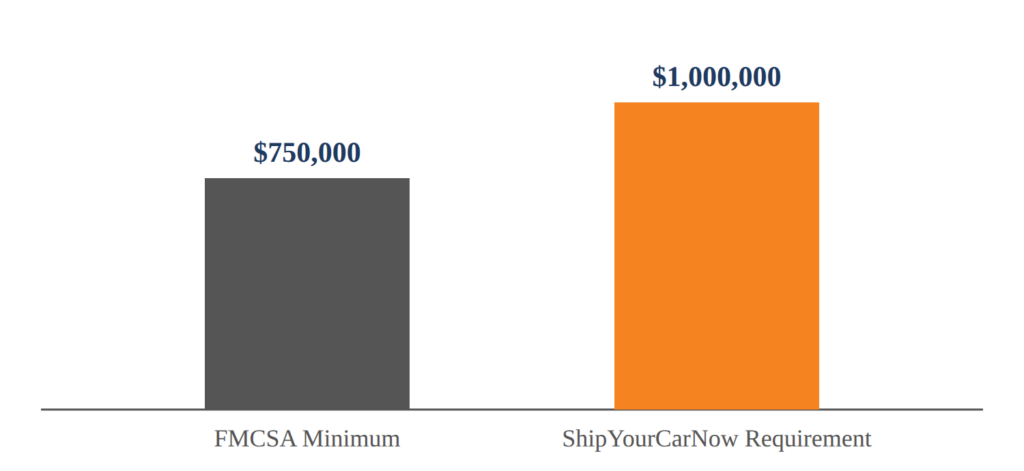
Every carrier in the ShipYourCarNow network also carries $100,000 in cargo insurance on top of this liability coverage.
Industry-wide, the damage rate on shipped vehicles runs around 0.50%, and carriers using top-tier trailer systems report rates as low as 0.19% to 0.22%. When damage does happen, the average drivable front-end claim now runs about $3,706, up nearly 40% since 2019 as vehicles have gotten more expensive to repair thanks to modern sensors and cameras. That’s part of why carrier vetting and claims handling matter as much as the insurance minimum itself.
- Insurance coverage protects against damage to your vehicle during transport, not the belongings inside it
- Personal belongings left in the vehicle are not covered by the carrier’s cargo insurance policy, so remove valuables before pickup
- Supplemental insurance, sometimes called contingent cargo insurance when a broker adds an extra layer on top of the carrier’s own policy, can be sourced for extra protection on high-value vehicles
- Document the vehicle’s existing condition on the Bill of Lading and photograph the vehicle before it ships
“We do claim the industry’s lowest claim rate based upon how much we vet our carriers and the understanding of carriers that working for ShipYourCarNow, there’s a different level of service that they have to provide.”
Marco Maggiore, CSO, ShipYourCarNow | LinkedIn
Watch Out: Never sign a Bill of Lading without checking it against your own photos first. It’s your record if a damage claim ever comes up.
Open Transport, Enclosed Transport, and Delivery Choices
Open transport is the most common and affordable option, and it works well for most standard vehicles. Open-air trailers are the industry standard for exactly that reason: budget-friendly and available on nearly every route. Enclosed transport protects vehicles from weather and road debris, which matters more for classic cars, luxury cars, and other high-value vehicles. Between open and enclosed transport, most companies that ship vehicles nationwide will walk you through which one fits your car and your budget.
- Door-to-door transport is preferred for convenience, since the carrier picks up and drops off at your specified addresses. Door-to-door pickup means you’re not driving to a terminal on either end
- Terminal-to-terminal delivery is often cheaper but less convenient, since you handle part of the pickup or delivery yourself
- Non-running and inoperable vehicles need carriers with winch equipment to transport vehicles that can’t move under their own power, which not every carrier has on hand
- Shipping multiple vehicles or international shipping both benefit from the extra coordination a broker provides, since multiple vehicles moving on one trip need a carrier with room for all of them
- Enclosed auto transport sometimes includes top load service, positioning your vehicle on the upper deck of the trailer for extra protection from road debris
How to Choose Between a Car Shipping Broker and a Carrier
Start with your route and timeline. If a carrier already services your exact pickup and delivery locations on a date that works for you, direct booking can be simple and effective. If your move crosses multiple states, needs a particular pickup window, or involves a non-running, luxury, or classic vehicle, a broker’s network typically gives you more reliable options.
- Verifying a company’s FMCSA registration is crucial when selecting a transporter, whether it’s a broker, a carrier, or one of the many car moving companies that operate as both
- Inspect the vehicle upon delivery to confirm its condition against the Bill of Lading before the driver leaves
- Give the vehicle a quarter tank of fuel for transport and check tire pressure before pickup, since a flat can delay loading
- Look for transparent pricing and no hidden fees. Any auto transporter worth using will explain the full cost upfront, not after your vehicle is already loaded
Checklist
✓ Written quote in hand
✓ Carrier’s FMCSA registration verified
✓ Bill of Lading reviewed against your own photos
✓ Personal items removed from the vehicle
✓ Quarter tank of fuel and tire pressure checked
“We consider ourselves more than a broker. We are an auto transport management company.”
Marco Maggiore, CSO, ShipYourCarNow | LinkedIn
Why ShipYourCarNow
If you decide a broker is the right fit, the vetting behind that broker matters as much as the decision itself. ShipYourCarNow has spent more than 17 years in the auto transport industry providing car transport services and vehicle shipping services nationwide, and the process is built around one idea: your car deserves the same care we’d give our own. That approach earned ShipYourCarNow the No. 1 spot in the 2026 major auto transport brokerage performance report, based on a 4.5 out of 5 customer rating and a strong on-time delivery record.
We’re FMCSA-licensed and BBB-accredited, and unlike many car transport companies, every carrier in our network goes through a stringent vetting process covering overall performance, individual driver performance, USDOT compliance, and insurance verification. Every carrier we assign carries a minimum of $1,000,000 in liability insurance and $100,000 in cargo insurance.
- A dedicated shipping coordinator is assigned to your order from booking through delivery, so you always know who to call
- Our Know Your Trucker program sends you the assigned driver’s photo, license information, and equipment confirmation before pickup
- Claims never get outsourced. Our in-house claims team handles issues directly, without adding a third party to the process
- Pricing is locked in once quoted, with transparent pricing and no hidden fees. The price we quote you is going to be the price we charge you when it comes to shipping your vehicle
- Support is available 24/7, every day of the year, for families, military personnel, and businesses alike, because cars don’t stop moving, and neither do we
- Thousands of verified customer reviews back this up across Google, BBB, Consumer Affairs, and BirdEye
Call us at (866) 390-0354 or get an instant car shipping quote to see how our auto transport services and vetted carrier network compare.
We break down how car shipping costs are calculated and how the car shipping process works if you want the full picture before you book. Depending on your vehicle and timeline, you may also want to compare open car shipping against enclosed car shipping, or look into door-to-door auto transport and expedited car shipping if your timeline is tight. Shipping under a PCS order? Our military vehicle shipping page covers what to expect, and our snowbird car shipping page covers seasonal routes. You can also read verified customer reviews from people who’ve already made this decision.
For insurance questions, our guide on how auto transport insurance works goes deeper than we can here. Shipping a collector car or something one of a kind? Start with classic and luxury car shipping. If your delivery point works better as a pickup location, terminal-to-terminal auto shipping may be worth a look, and if your vehicle is headed outside the country, see international car shipping services. More questions? Our car shipping FAQs page covers the rest.
Ready to ship your vehicle with a broker who vets every carrier before it touches your car?
Frequently Asked Questions
What is the difference between a car shipping broker and a carrier?
A carrier owns the truck and physically drives your vehicle to its destination. A car shipping broker arranges the shipment on your behalf, matching you with a vetted carrier from a much wider network. Brokers also handle communication, scheduling, and problem-solving throughout the process, while carriers focus mainly on the drive itself.
Can a car shipping broker also be a carrier?
Yes, some companies hold both broker and carrier authority with the FMCSA, which lets them either dispatch their own trucks or coordinate through a carrier network depending on the shipment. Most auto transport management companies operate primarily as brokers while holding the carriers in their network to strict standards. Ask any provider directly which role they’re playing for your shipment.
How do car shipping brokers pay carriers?
Brokers negotiate a rate with the carrier assigned to your shipment, separate from the price you’re quoted as the customer. Payment usually happens after pickup or delivery, depending on the broker’s agreement with that carrier. A transparent broker should be able to explain this process if you ask.
Why do most people choose a broker over booking a carrier directly?
Most people who ship cars go with a broker because it opens up carrier availability beyond what one company can offer. Brokers are typically preferred for shipping unusual routes or tight schedules, since they can match a shipment to whichever carrier in their network fits best. That flexibility matters most for cross-country moves, non-running vehicles, or specialty transport like enclosed carriers.
What happens if a broker does not pay a carrier?
A carrier that hasn’t been paid can refuse to release the vehicle at delivery until the payment issue is resolved, which is a real risk with disorganized or fly-by-night brokers. This is one reason carrier vetting and broker reputation matter as much as price when comparing quotes. Working with an established broker that has its own in-house claims and accounts team reduces this risk considerably.
What are the different types of carriers in auto transport?
Carriers vary by equipment type, including open carriers, enclosed carriers, and specialized equipment for non-running or oversized vehicles. Some carriers run multi-car haulers built to ship vehicles along fixed long-distance lanes, while others operate smaller trucks for regional or local vehicle transportation. The right carrier type depends on your vehicle, route, and how much protection it needs during your shipping service.
Is it cheaper to book directly with a carrier instead of using a broker?
Not necessarily. Shipping costs depend more on route demand, vehicle size, and timing than on whether you book through a broker or a carrier. A carrier’s direct quote can look lower upfront, but that price only holds if the carrier already services your exact route and pickup date.
How much does it cost to ship a car?
Most shipments run between $600 and $1,925 total, depending on distance, vehicle type, and time of year. A short trip under 500 miles typically runs from $600 to $930, a 500- to 1,000-mile move runs from $800 to $1,250, and a cross-country shipment more than 2,500 miles typically runs from $1,350 to $1,925. Larger vehicles, remote area pickup or delivery locations, and inoperable vehicles all push the price higher, while metro-to-metro routes and terminal-to-terminal pickup tend to cost less.
Does the time of year affect car shipping costs?
Yes. The busiest and most expensive stretch is the northbound snowbird migration window, roughly April 6 through May 10, when prices can run 10 to 20 percent above fall rates. A second, similar spike hits the fall southbound window, roughly October 16 through November 20, and summer relocations plus August college move-ins add extra demand in between. January through March is typically the slowest and most affordable stretch, though severe winter weather can still bottleneck certain routes and cause temporary rate increases even in a slower month.
How do I know if a company is a broker or a carrier?
You can check a company’s FMCSA registration through the agency’s SAFER database, which shows whether the business holds broker authority, carrier authority, or both. Verifying a company’s FMCSA registration is crucial when selecting a transporter, regardless of which role it plays. Legitimate companies won’t hesitate to share their USDOT and MC numbers when you ask.
Can a non-running or inoperable vehicle be shipped through a broker?
Yes, non-running and inoperable vehicles can be shipped, but they require a carrier with winch equipment to load the vehicle without power. Most carriers reserve their standard rates for operable vehicles, so expect an inoperable vehicle to add roughly $150 to $350 to the shipping cost due to the specialized handling involved. A broker can match your shipment to a carrier that has exactly the right equipment, which is often harder to find on your own.
Is my vehicle insured during transport with a broker or a carrier?
Your vehicle is covered by the carrier’s cargo insurance policy while it’s in transit, regardless of whether you booked through a broker or directly. The FMCSA requires a minimum of $750,000 in liability insurance for interstate motor carriers, though reputable brokers often require more from the carriers in their network. Always confirm the exact coverage amount before your vehicle ships, and remember that personal belongings left inside are not covered, which is one more reason to know exactly who you’re working with before you choose a car shipping broker.






Senior automotive logistics professional with a passion for the industry and a 10+ year history of accomplishments. Proven track record of exemplary client management working with both RMCs, Van Lines and OEMs. Keen ability to react to an ever-changing marketplace while offering superior technology solutions, programs and services. Architect of award winning auto transport portal technology offering transparency and agility to clients, agents and transferees. Successful team builder and leader easily managing budgets with effective leadership, strategic planning, and problem-solving capabilities.